Introduction: A World That Endured
It is 2100.
The long battle to slow, stop, and finally roll back global warming may be nearing its end.
It’s easy to assume that the battle was won. The world’s human population stands at about 10 billion. Modern societies are much wealthier and healthier than those of the early 21st century.
And technology is changing what it means to be human. Most people have cybernetic implants and enhancements. It’s no longer easy to distinguish between biological and synthetic humans.
I imagine that today’s world must have seemed like an impossible dream in 2046, when my parents were born in Charleston. Then, an estimated 60 million people had just died in the Great Hunger. The world had warmed by 2 °C, relative to its average temperature in the late 19th century. Ecosystems were collapsing, led by coral reefs.
It’s hard to piece together how people felt, so many decades ago. But it must have looked like there would never again be enough food to go around. Like the Earth was destined to heat up until there was no place left for billions of people.
I imagine that humanity looked like it was doomed. But 2046 was not the beginning of the end of the human story.
In the decades that followed, societies didn’t exactly solve the climate crisis. Instead, governments and institutions worked to contain it. Through a combination of emergency geoengineering, uneven adaptation, and partial decarbonization, global temperatures stopped rising, then started to decline.
Much was lost.
Charleston was evacuated. Thousands of its most vulnerable people died, and many of its buildings were ruined. But its population returned, and rebuilt. Today, the city is growing again.
Global civilization has survived, even thrived. And Earth remains habitable – in most places.
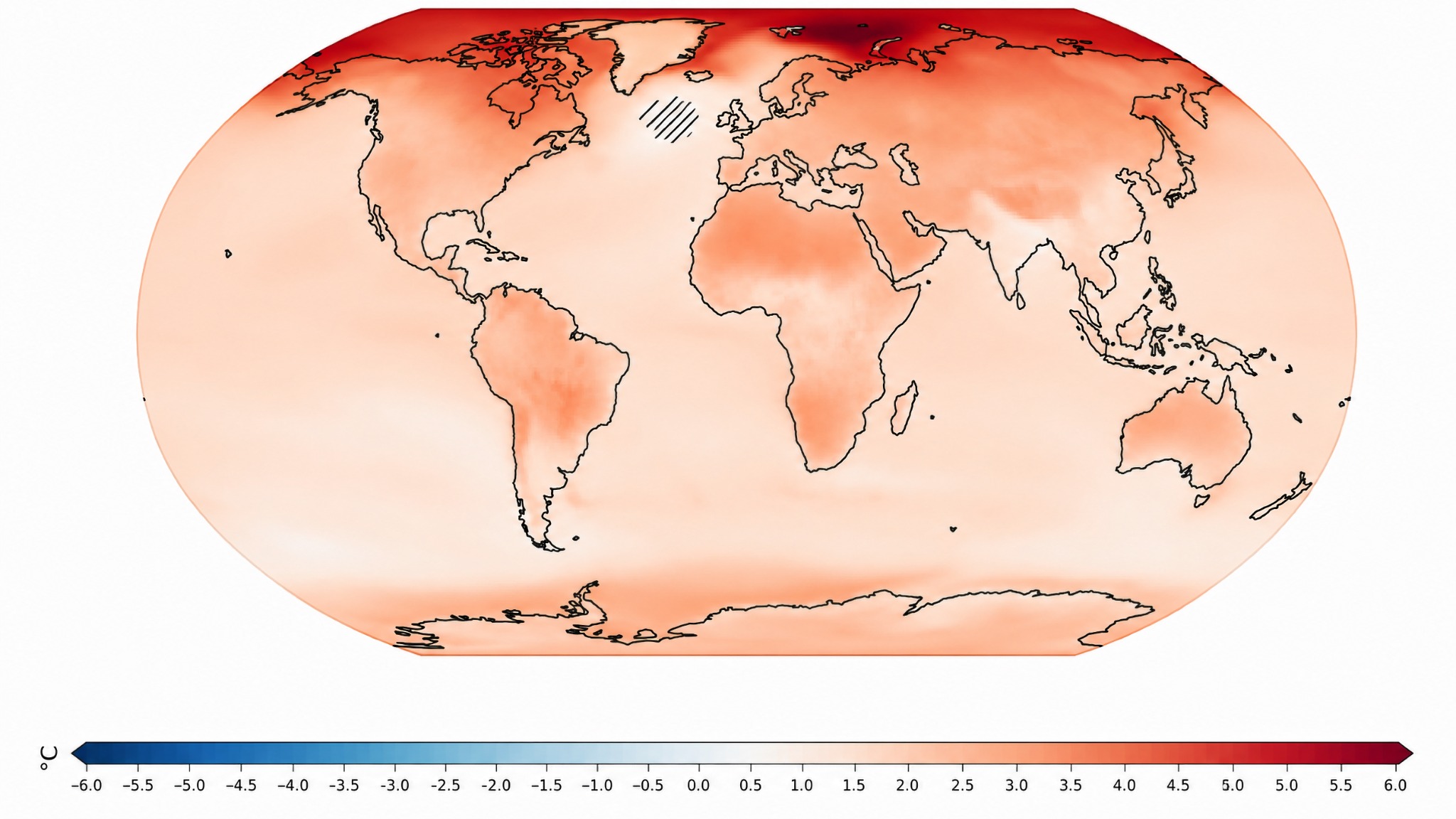
This map simulates regional temperature change when Earth has warmed by 1.5 °C, relative to its average temperature in the late nineteenth century. It is a modified version of an image obtainable from the IPCC WGI Interactive Atlas. Source: Intergovernmental Panel on Climate Change, “WGI Interactive Atlas,” accessed August 10, 2026.
2046-2056: The Geneva Climate Compact
By 2046, electricity generated by renewables had been surging for about three decades. It wasn’t enough.
Part of the problem was that although fossil fuels supplied a smaller proportion of the world’s total energy, they still provided just as much energy, overall, as they had two decades earlier. Another part was that emissions from land – rather than industry or transportation – continued to rise.
Population growth and economic development fueled a steady increase in demand for food, especially high-protein dairy and meat. In the tropics, ranchers burned rainforests to make way for fields and cattle farming. Livestock grazing consumed about a third of the world’s land.
Because forests usually absorbed more carbon dioxide than they released while clearing and maintaining fields – especially for cattle – did not, food production was a growing contributor to global warming. By 2046, the electrical grid may have gotten cleaner, but cultivated land had not.
In the wake of the Great Hunger, many noticed the irony: the world’s food system had succumbed to a disaster partly of its own making.
Regional heatwaves, droughts, and wildfires were not new in the 2040s, but arable land had always recovered quickly. Now, in the face of extreme weather on a truly global scale, and in the wake of decades of unsustainable groundwater depletion, vast stretches of farmland were abandoned across the world’s breadbaskets.
According to my grandparents, even in small, wealthy cities like Charleston, South Carolina, grocery store shelves were often empty. Food banks were routinely overrun.
The United Nations Secretary-General convened an emergency session in late 2047, the first of its kind since the COVID-19 pandemic. During the Great Hunger, inflation had reached such highs, and the death toll seemed so extreme, that inaction was politically untenable – even for the most reluctant governments.
The European Union drafted a provisional framework for coordinated climate intervention, drawing on climate finance mechanisms that had been debated but underfunded for decades. The United States and China, both facing domestic political crises, signed on early. Governments that initially resisted the agreement, ostensibly to preserve national sovereignty, found that the famine had eroded their leverage.
Finally, in 2049, the Geneva Climate Compact came into force.
It operated on two tracks. The first brought in the countries that had lacked the technology or capital to transition away from fossil fuels – countries such as Vietnam, Thailand, Pakistan, Nigeria, Malaysia, and Indonesia. Wealthy signatories agreed to provide concessional loans, grants, and direct technology transfer to help poorer countries build out solar or wind capacity. For the receiving nations, the famine had removed any remaining hesitation. They signed because they had no other options.
The second track bound the world’s largest economies to accelerated decarbonization timelines. China, India, and the United States were most important - for different reasons.
By 2049, about a third of the world’s carbon dioxide emissions came from China. That was only a slight reduction from China’s contribution to those emissions about 20 years earlier.
India was the world’s fastest-growing economy, and electricity generated by renewables had surged across the country – but so had total power generation. India’s carbon dioxide emissions were therefore rising quickly.
The United States, the world’s largest oil and natural gas exporter for nearly 30 years, had periodically used its influence to thwart global efforts to roll back fossil fuel consumption.
Now, the three superpowers joined other signatories in committing to phase out coal; expand solar and wind power; and subsidize a shift toward regenerative agriculture. In practice, that meant measures such as cover cropping, no-till farming, and agroforestry: all intended to restore carbon to soils that had lost much of it through decades of intensive cultivation.
Not since the 2015 Paris Agreement had a diplomatic breakthrough created real hope for solving the crisis of climate change.
2056-2061: The Impacts of Climate Change Intensify
In the early 2050s, technology transfers were beginning to show results across Southeast Asia.
Vietnam and Indonesia rapidly scaled up solar capacity, reducing their dependence on coal. India’s regenerative soil subsidies were rebuilding soil health in the parts of Punjab that were devastated by the 2044-45 El Niño.
But the atmosphere didn’t respond to political timelines.
In many cities, dangerous heatwaves and suffocating wildfire smoke made life unbearable for weeks at a time. Devastating storms and floods were now routine disasters.
Vectors for disease, such as ticks and mosquitoes, had spread far beyond their 20th-century ranges. Epidemics happened far more frequently, as crumbling ecosystems led to more and more chance encounters between wild animals, with their unfamiliar bacteria or viruses, and people.
Poring through reams of mortality data, AI analysts warned that global warming was, indirectly, becoming a major cause of death. But even in that grim context, two disasters stood out.
In August 2056, Super Typhoon Vera made landfall in the northern Philippines with sustained wind speeds exceeding 330 kilometers per hour – stronger than anything the archipelago had endured in recorded history.
Computer simulations of Earth’s climate – known as climate models – had long indicated that while the total number of tropical cyclones might decrease in a warming world, the proportion reaching super typhoon intensity would increase dramatically, as warmer ocean surfaces pumped more energy into increasingly devastating storms.
Vera revealed just how deadly the new “category 6” cyclones could be. Storm surges swallowed coastal rice paddies that had only just begun to recover from the Great Hunger. Owing in part to sea level increases, many were permanently inundated.
Hundreds of thousands were displaced into a relief system already strained by years of food insecurity. Some 28,000 people died – immediately, during the floods, and later, owing to shortages of food and medicine. It was the worst natural disaster in the history of the Philippines.
Then, in the summer of 2061, Hurricane Celeste, another category 6 storm, made landfall near Charleston with sustained wind speeds that rivaled Vera’s. The hurricane approached the coast as a category 1, and many didn’t heed evacuation orders. But just before landfall, it intensified with unprecedented speed. Thousands of people suddenly faced the worst hurricane in American history.
Flooding caused by storm surges, combined with extreme winds, killed over 13,000 people, and displaced hundreds of thousands more along the eastern seaboard. Tens of thousands of structures were destroyed or damaged beyond repair, including most buildings in Charleston’s historic city center. Estimated damages exceeded $2 trillion (in 2061 USD) for the first time in American history. But the worst losses couldn’t be quantified.
My parents lived in Charleston, and were teenagers at the time. They were among the few to evacuate. But their family – my family – never really recovered. My parents lost two cousins, nine and twelve years old, and their aunt. They lost their childhood home, their school, and some of their best friends.
Worse still, climate disasters increasingly compounded each other. When Celeste passed, for example, a heatwave pushed temperatures across South Carolina beyond 38 °C – about 100 °F – for over a week. Because millions were without air conditioning and the health system no longer functioned, tens of thousands died. The heat wave only ended with a torrential rainstorm that caused renewed flooding, killing thousands more.
There was no relief. And death was everywhere.
Worldwide polling suggested mounting confusion, frustration, and despair. Decarbonization efforts seemed to be advancing quickly. Warming appeared on track to stabilize below 2.5 °C, relative to Earth’s average temperature in the late 19th century. The global community had finally gotten serious about solving climate change.
Yet the impacts of global warming seemed to be escalating. Disasters were multiplying, and increasingly connected. People were dying in unprecedented numbers.
Some of the most frightening transformations happened out of sight, at the poles.
In the early 21st century, the Greenland Ice Sheet was already losing some 264 billion tons of ice per year. But in 2061 alone, AI systems estimated that nearly 1 trillion tons had been lost.
Owing both to water melting from ice sheets into the oceans, and to the expanding volume of warmer water, sea levels were now more than a foot higher than they had been at the start of the 21st century. Regular flooding at high tide was beginning to require permanent evacuations in many countries.
Worse, the Atlantic Ocean currents that stabilize Earth’s climate seemed to be weakening. These currents, known collectively as the Atlantic Meridional Overturning Circulation (AMOC), had long pushed warm, salty water from the equator to the North Atlantic. As the water moved north, it got colder, and because it was especially salty, it was dense. It sank into the deep ocean, cooled, then returned south.
For thousands of years, the salinity of cooling water from the tropics had kept the AMOC moving. Now, the water was beginning to stay warm. And freshwater melting off the Greenland Ice Sheet was making it less salty.
AI forecasters predicted that the AMOC was poised to slow down dramatically – a possibility that climatologists had been warning about for decades. Because winds blowing from the west over the warm, salty currents of the AMOC gave Europe its mild climate, an AMOC slowdown tantamount to a collapse threatened to abruptly cool the continent, at least during the winter.
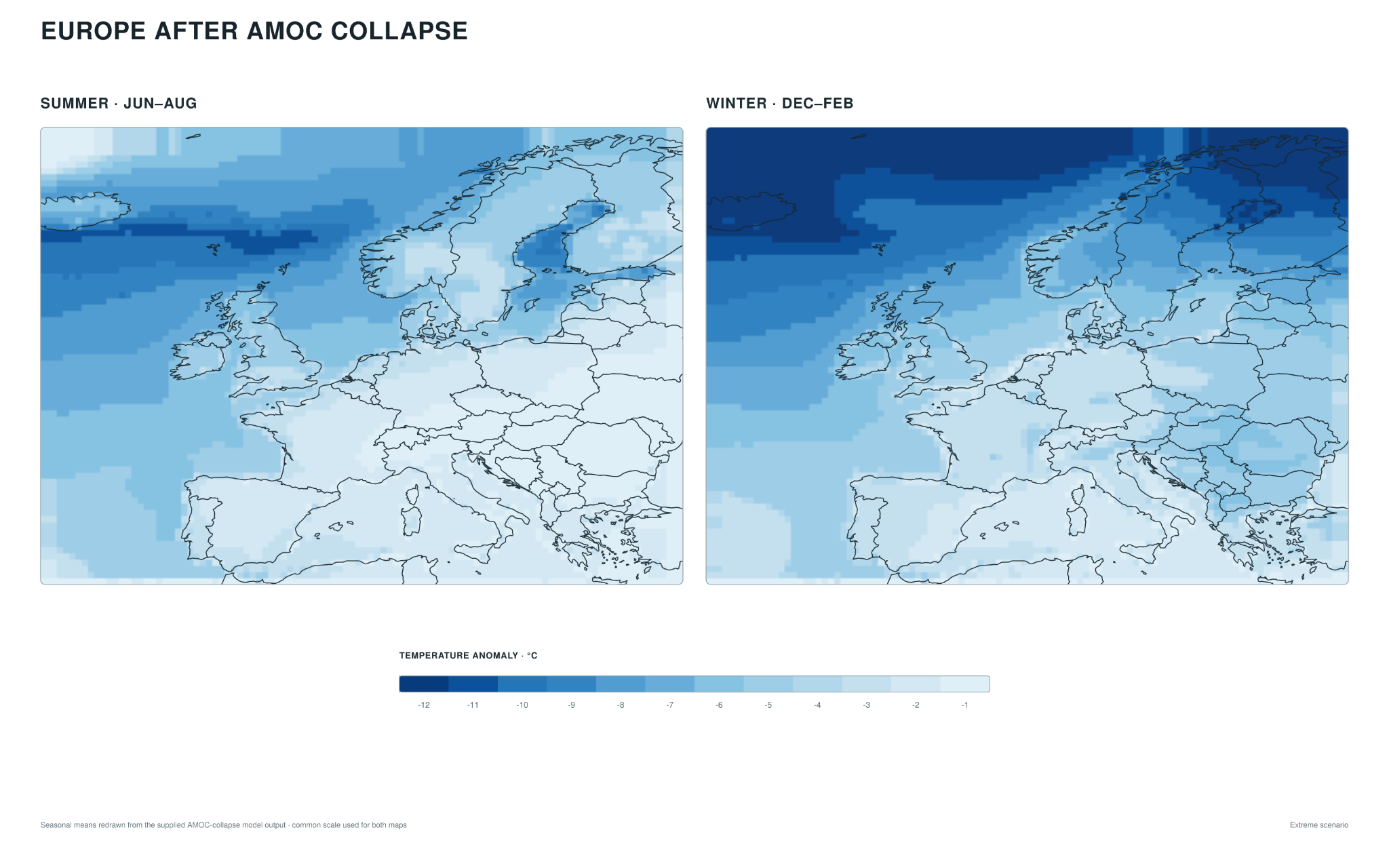
A simulation of temperature anomalies across Europe, in summer and winter, following a dramatic slowdown of the Atlantic Meridional Overturning Circulation. Developed using Figure 4 in Jackson, Laura C. et al., “Global and European climate impacts of a slowdown of the AMOC in a high resolution GCM.” Climate Dynamics 45:11 (2015): 3299-3316.
By rerouting the circulation of the atmosphere, an AMOC breakdown also threatened to catastrophically weaken the monsoons that provided life-giving rains across Africa and Asia. A multiple breadbasket failure would become a permanent reality. Hundreds of millions, perhaps billions of lives were at risk.
Governments had waited too long to slash greenhouse gas emissions. Decarbonization, by itself, no longer felt like it could prevent a global demographic and economic collapse.
2061-64: Geoengineering Offers a Lifeline
With no time to spare, some governments funneled tens of billions of dollars into ambitious geoengineering experiments.
Geoengineering is a deliberate, large-scale intervention in Earth’s climate system that counteracts global warming. Such interventions had been simulated using computer models but never tested on a scale that could actually induce local cooling – partly because real-world experiments raised public concerns about tampering with the atmosphere.
Now, the risks seemed worth it.
Solar radiation modification (SRM) appeared to be the most promising approach to geoengineering.
One version of SRM, known as stratospheric aerosol injection (SAI), would inject aerosols – particles or droplets suspended in air – into the stratosphere, where they’d form particles that scattered a small fraction of incoming sunlight back into space. The stratosphere would warm up, but the lower atmosphere would cool down. SAI seemed like the geoengineering method that would be easiest to deploy and most likely to work at scale, because it roughly copied how explosive volcanic eruptions had long cooled the Earth.
But a series of experiments that released aerosols into the stratosphere confirmed what climate models had long simulated: SAI not only lowered temperatures, it also reduced evaporation and redirected prevailing winds in ways that increased the intensity of droughts in some regions, such as West Africa, even as it eased droughts elsewhere.
Both the African Union and the European Union therefore joined governments across Oceania and South Asia in supporting intensified research into other forms of geoengineering. Scientists experimented with marine cloud brightening (MCB), an SRM technique that sprays a fine seawater mist into the air beneath ocean clouds. As the mist evaporates, it leaves microscopic salt particles around which water condenses, creating more and smaller cloud droplets. The droplets make clouds more reflective, reducing the sunlight that reaches the ocean.
Sustained experiments confirmed that MCB could modestly lower sea-surface temperatures. And as expected, cooling was strongest near the treated clouds.
Geoengineering had long been a fringe idea. For decades it had been promoted by a group of outspoken scientists, engineers, and policy professionals – even as it was condemned by most climatologists and environmentalists, and rejected by many governments. Public opinion was divided, and popular opposition had thwarted early attempts at geoengineering experiments.
But by the early 2060s, a once-marginal idea seemed increasingly inevitable. Governments agreed that the climate would either be geoengineered or it would break down, destroying ecosystems – and perhaps humanity – forever.
In the end, it wasn’t a difficult choice.
2064-2080: Geoengineering Stops Global Warming
On March 17, 2064, after months of negotiation with European and North American allies, the Danish government authorized the world’s first sustained MCB deployment.
A small fleet of retrofitted Royal Danish Navy vessels began operating west of Greenland, dispersing a fine mist of seawater into low-lying marine clouds. The goal was not to reverse global warming, but to locally reduce incoming solar radiation and thereby slow the loss of ice from the Greenland Ice Sheet.

This visualization depicts the Danish marine cloud brightening effort as of May 17th, 2069. The image was generated using pictures published by NOAA’s National Environmental Satellite, Data, and Information Service and WhoWhatWhy.
After decades of modeling, laboratory work, and limited field trials, MCB had become technically viable.
Public opinion began to shift. A generation shaped by waves of deadly and unprecedented climate shocks was willing to accept deliberate alterations of the atmosphere that promised to cut the risk of extreme weather. Even those who feared the unintended side effects of geoengineering were more likely to condemn previous generations for their inaction than to criticize present efforts to directly stabilize the climate.
Early results were modest, but noticeable. Within a few years, regional surface temperatures in parts of the North Atlantic stopped rising, then started to decline. The rate of ice loss from some Greenland outlet glaciers slowed down. There were also tentative signs that the AMOC was no longer weakening with the same speed.
But the side effects were quickly apparent. Changes in cloud cover altered regional energy balances in ways that extended beyond the deployment zone. Climate models had long suggested that modifying clouds in the North Atlantic could shift atmospheric circulation patterns, and by the mid-2060s, rainfall across parts of West Africa had declined measurably. The signal was difficult to separate from existing climate variability, but the trend was persistent enough to trigger political alarm.
West African governments had opposed SRM precisely because it could reduce regional rainfall. Now, the MCB efforts they had initially supported seemed to generate a similar result. Supported by international advocacy groups, many began pressing for compensation and formal oversight mechanisms.
New disputes fed into a broader and increasingly urgent debate over the “law of the atmosphere.” Who had the authority to alter shared climatic systems? Could regional coalitions deploy interventions with global consequences?
By the late 2060s, negotiations over governance frameworks threatened to derail the Danish MCB effort. Yet AI systems were eventually able to quantify the relationship between MCB and regional droughts – at least, enough to satisfy many governments. Since the relationship turned out to be modest, compensation could be worked out through the Geneva Climate Compact.
Now the MCB sector expanded rapidly. By 2070, hundreds of firms, ranging from small startups to major engineering consortia, were developing dispersal systems, modeling platforms, and monitoring tools.
Some MCB efforts focused on ecosystem protection. Across the remnants of the Great Barrier Reef, for example, Australian-led projects used MCB deployments to reduce peak water temperatures during marine heatwaves. The frequency and severity of coral bleaching declined, raising hopes that parts of the reef could be restored by the end of the century.
Elsewhere, larger deployments followed. A U.S.-backed consortium began operations over parts of the Southern Ocean, aiming to reduce heat uptake near Antarctic ice shelves. Over time, observations suggested a slight reduction in melt rates in some vulnerable regions, though attribution remained contested.
In 2072, Japan and South Korea launched the Pacific Cooling Initiative, coordinating MCB operations in several persistent stratocumulus cloud zones. The program became an early example of sustained regional cooperation in climate intervention.
Innovation and deployment of technologies that directly pulled carbon dioxide out of the atmosphere advanced more slowly, but with fewer geopolitical risks.
In 2073, China announced the first large-scale deployment of its CarbonBox direct air capture (DAC) systems, powered by decades of investment in low-carbon energy. These facilities used chemical processes to extract carbon dioxide from the atmosphere, storing it underground or converting it into industrial feedstocks: raw materials that could be used to create finished products. The advent of large-scale DAC seemed to represent a shift toward addressing the root cause of warming, rather than its immediate symptoms.
By the late 2070s, MCB efforts altered cloud cover above some 12% of the world’s oceans, in key regions that were most vulnerable to warming. The net global cooling effect amounted to a few tenths of a degree Celsius.
It was a small number, but it bought crucial time for ongoing decarbonization efforts. Not only did it preserve ocean ecosystems and currents; it allowed global temperatures to be stabilized at 2 °C above their average in the late 19th century. And because both the frequency and severity of weather extremes had been fueled not only by the average temperature of the planet but also by the planet’s rate of warming, Earth was suddenly a less dangerous place.
In 2079, AI systems estimated that decarbonization and geoengineering had sharply lowered the risk of multiple breadbasket failures. The AMOC no longer seemed to be weakening. Sea levels were still rising, but the rate at which they were rising was expected to decline over the coming century.
Coastal ecosystems still needed restoration; sea walls had to be built or strengthened along the world’s shores. But it seemed likely that many corals could be restored, and that future flooding would be manageable.
Still, all this progress hinged on continued international cooperation. Both geoengineering and decarbonization efforts would need to be sustained for decades, or the climate crisis would come roaring back – and billions could still die.
2080-2100: Phasing Out
As the geoengineering industry boomed, its critics multiplied – even as warming slowed down.
By the early 2080s, regulatory battles were unfolding in courts and international forums around the world. Governments struggled to define the legal boundaries of MCB, because AI systems estimated that the downstream effects of MCB on wind patterns and rainfall were becoming more severe. That made them ever harder to address through the Geneva Climate Compact.
In parts of West Africa, for example, seasonal rains declined over several consecutive years. Governments in the Global North could reimburse farmers for lost harvests, but did they also have to pay for rising food prices? And how could governments compensate for dust storms, or for migration from country to city?
AI systems also began to detect subtle but persistent changes in atmospheric chemistry, including modest regional fluctuations in ozone concentrations. These changes were not catastrophic – not yet – but they reinforced a growing sense that the climate system was being altered in ways that were dangerous and increasingly unfair.
Another concern loomed even larger: what would happen if MCB stopped.
Climate models had long warned of the possibility of a termination shock: a rapid spike in temperatures if geoengineering were suddenly halted while greenhouse gas concentrations remained high. The rise in temperatures could be much faster than it had been before geoengineering projects had been implemented. The weather extremes that had killed millions would return, worse than ever.
By the 2080s, this was no longer an abstract risk. Geopolitical tensions were rising, not least because of the perceived impacts of geoengineering on drought. A world war seemed increasingly plausible, and many found it unlikely that MCB could be sustained if and when hostilities broke out.
Then, in 2085, a truly severe drought spread across West Africa, devastating food and water systems that remained fragile. Regional governments blamed the drought on the Danish MCB operation in the North Atlantic, and demanded unprecedented compensation.
The perception of causation spread more quickly than the science, fueling international outrage. Regional governments banded together with governments across the Global South that believed their countries had been warmed by MCB efforts. Environmental activists accused wealthy nations of reshaping the climate in their favor, at others’ expense.
The geoengineering sector responded forcefully, emphasizing the dangers of stopping MCB programs too quickly. AI advisors and scientists agreed: if MCB were to be reduced, it would have to be done gradually, over decades, with international coordination.
That conclusion led to a pivotal meeting in Seoul on November 17, 2087. Representatives from major powers, vulnerable states, and key scientific institutions convened to negotiate what became known as the Seoul Accords. They agreed to establish a 20-year framework for scaling back MCB operations, paired with continued emissions reductions and expanded carbon removal. They also created a new international body, the Global Climate Intervention Monitoring Agency, tasked with tracking atmospheric conditions in real time and adjusting interventions if warming exceeded agreed thresholds.
Equally important was the creation of a larger compensation fund, financed primarily by the governments and corporations that had led MCB deployment. The fund directed resources to regions demonstrably harmed by climate interventions, including much of West Africa.
The arrangement was contentious, particularly among private firms that had invested heavily in geoengineering infrastructure. Yet the alternative – a fragmented system of unregulated interventions, with the constant risk of conflict and abrupt termination – was now seen as fragile and dangerous.
In any case, by the 2090s, decarbonization efforts were beginning to remove the need for MCB interventions. Energy systems approached net zero emissions, meaning that humans no longer released more greenhouse gases into the atmosphere than they removed. Direct air capture had expanded, and now removed meaningful quantities of carbon dioxide from the atmosphere.
Agricultural systems had also adapted, with drought-resistant crops and large-scale reforestation helping to stabilize the bread baskets. Coastal cities, including places like Charleston, had fortified themselves against flooding and storms.
The world of 2100 is no paradise. Ice sheets continue to lose some mass. Ecosystems remain under pressure. But warming has slowed and, for the first time in generations, the world’s average temperature is less than 2 °C hotter than it was in the late 19th century. Given current policies and economic trends, global temperatures should drop by another 0.5 °C over the course of the 22nd century.
If so, we might be able to restore the world our ancestors lived in, 75 years ago.

A recent image of Charleston depicts a thriving but chastened city. Many cities devastated by climate disasters rebuilt with architecture that emphasized sustainability and strength, rather than cost, marketability, or aesthetics.
2100: Back From the Brink
Looking back, it’s clear that geoengineering could not, by itself, “solve” the climate crisis. The only way to do that was to lower concentrations of greenhouse gases in the atmosphere.
But geoengineering could buy time, a precious reprieve from the escalating consequences of global warming. Because it was also a precarious reprieve, much depended on what was done with it.
Fortunately, governments around the world created powerful incentives for renewable energy, electric vehicles, low-carbon industry, and regenerative agriculture. As investment poured into new technologies and practices, the green economy expanded at extraordinary speed.
Fewer people died from airborne pollution. The oil-driven conflicts of the twentieth and early twenty-first century were a distant memory.
And greenhouse gas emissions began to fall. Eventually, atmospheric concentrations stabilized – then began to decline, ever so slowly.
It was enough. The reprieve provided by geoengineering may have saved billions of lives, and perhaps humanity’s very future. It gave societies the breathing room they needed to complete a transition that could otherwise have come too late.
It’s strange to think that, if recent history had unfolded just a bit differently, Earth would be a totally different planet today. A planet heating too quickly for societies to adapt, not to mention the plants and animals on which human life depends.
Millions, perhaps billions might already be dead.
Maybe a second storm like Celeste would have torn through South Carolina. This time, nobody would have been around to rebuild. I might not have been born.
And another student – halfway around the world, perhaps – would have written a very different essay.