Introduction: A Failed Experiment
These days, in Buraidah, Saudi Arabia, summer temperatures regularly exceed 50°C.
By late morning, the streets are empty. Outdoor work is impossible. Even short walks can be deadly – especially in humid weather when the body can no longer cool itself through sweat.
Every summer, thousands die.
This was not my parents’ world. I was born in Jeddah, on the Red Sea coast, where my family owned a small resort. In my earliest memories, the sea still felt alive. But by the time we left, the reefs had turned white and brittle. The water had grown uncomfortably warm, and the shoreline flooded during high tides.
We left in 2091, when I was eleven. I still remember: some of our neighbors said the heat would pass. They said the world had already solved climate change once, and that it would do so again. They believed that the crisis we were living through couldn’t last.
They were wrong.
What we lived through was something scientists had long warned about. A termination shock, an abrupt surge in global temperatures following the collapse of a geoengineering program. One that had cooled the Earth even as greenhouse gases continued to add up in the atmosphere.
That phrase, “termination shock,” can’t capture what it felt like.
The heat didn’t simply return. It arrived in devastating, utterly unprecedented heatwaves and droughts. The rate of warming was seven times higher than it had been during the 2046 Great Hunger. This time, the death toll can be measured in the hundreds of millions, perhaps the billions – at least if early estimates are to be believed.
Humanity is on the brink. And to understand why, you have to begin in 2046, when governments agreed to cool the planet not by reducing emissions, but by dimming the Sun.
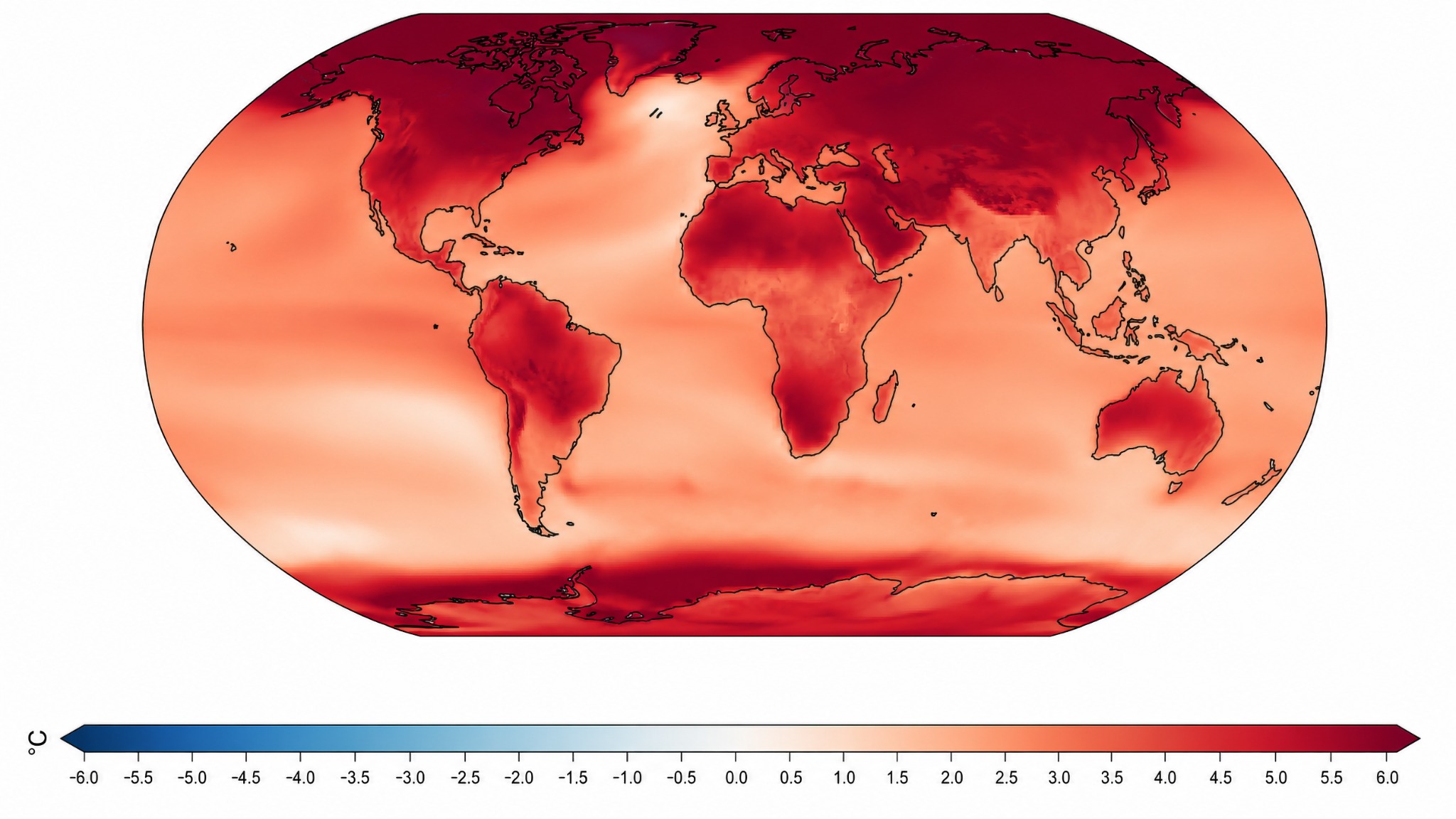
This map simulates regional temperature change when Earth has warmed by 4 °C, relative to its average temperature in the late nineteenth century. It is a modified version of an image obtainable from the IPCC WGI Interactive Atlas. Source: Intergovernmental Panel on Climate Change, “WGI Interactive Atlas,” accessed August 10, 2026.
2046–2051: The Quick Fix
After the Great Hunger, governments faced a terrifying reality: the global food system had failed under conditions that scientists had long warned were possible when warming approached 2°C, relative to the world’s average temperature in the late 19th century.
Multiple breadbasket regions had experienced simultaneous drought and heat. Harvests failed everywhere. There was no surplus to compensate. Tens of millions died, governments collapsed, and global trade broke down.
At the emergency United Nations session that followed, there was widespread agreement that conventional climate policy had not been sufficient to prevent catastrophe. AI systems estimated that even an implausibly aggressive campaign to reduce emissions could not prevent the likely recurrence of multiple breadbasket failures. And no amount of adaptation – genetically engineering more drought-resilient crops, for example, or investing in indoor, controlled-environment agriculture – seemed sufficient.
Attention therefore turned to geoengineering: deliberate, large-scale interventions in Earth’s climate system to slow down or even reverse global warming.
Policymakers weighed two approaches. The first involved removing greenhouse gases from the atmosphere. Options included scaling up technologies like direct air capture, which uses chemical processes to pull carbon dioxide out of the air, or growing trillions of trees. The advantage of this approach was that it would actually address the most important cause of global warming: carbon dioxide concentrations in the atmosphere.
But it was quickly apparent that, despite decades of investment, carbon dioxide removal infrastructure could not scale up quickly enough to counteract the vast emissions of greenhouse gases still pouring into the atmosphere. Owing to increasingly severe forest fires and the spread of wood-boring beetles in warming weather, many forests also released more carbon dioxide than they absorbed. And even the world’s most capable AI models could not confirm that exotic carbon dioxide removal possibilities – such as a plan to fertilize the oceans with iron to encourage the reproduction of carbon-absorbing plankton – could actually work.
The second approach involved changing how much sunlight the Earth absorbs. The rapid growth of the space industry over the past three decades led some to suggest that it was now possible to install a swarm of tiny sunshades at L1, the so-called first Lagrange point, where the gravitational pull of the Earth and Sun balance each other. The swarm would block a tiny fraction of incoming solar radiation, enough to counteract the warming effect of greenhouse gas emissions. And because the gravitational fields of the Earth and Sun counteracted each other so perfectly, the swarm could remain in place with minimal intervention.
But enthusiastic support for the plan by controversial tech entrepreneurs, combined with the vocal opposition of influential climatologists, led to intense public skepticism about the feasibility of a sunshade swarm. Governments therefore turned to another possibility for reducing incoming solar radiation: solar radiation modification (SRM).
A form of SRM called stratospheric aerosol injection (SAI) seemed promising because it replicated a proven mechanism for cooling the climate: the eruption of explosive volcanoes. Such volcanoes hurl sulfuric gases into the stratosphere, the layer of the atmosphere above weather systems. There, the gas forms tiny reflective particles – sulfate aerosols – that scatter and absorb sunlight. The particles, known collectively as a volcanic dust veil, reduce the amount of solar energy reaching Earth’s surface, temporarily cooling the planet.
It was easy for activist scientists to sell SAI to policymakers and the public because they could argue that it simply reproduced a natural process. Aircraft would fly 18 to 22 kilometers above sea level, releasing sulfur dioxide into the stratosphere. Winds would spread the resulting aerosols around the globe, forming an artificial dust veil.
Because these particles would remain in the stratosphere for only about one to two years, SAI could easily be abandoned if it didn’t work, or if its side effects proved too severe. Of course, if it did work, it would require constant replenishment.
The attraction of SAI was not just that it seemed like a proven method for cooling the Earth. It was also the speed at which it seemed capable of lowering global temperatures. Unlike emissions reductions, which could take decades to clearly impact worldwide temperatures, let alone a swarm of miniature spacecraft, which would take many years to manufacture and position, SAI could produce measurable cooling within months.
Climatologists warned that SAI would also create profound new risks.
Climate models – computer simulations of Earth’s climate – had long indicated that SAI could dry out some regions, even as it restored moisture to others. By lowering rates of evaporation, SAI promised to keep more water in the soil across many of the world’s breadbaskets. But with less evaporation, less water would enter the atmosphere, while a colder atmosphere could also hold less water.
Models simulated that over much of central Africa, for example, less rain would fall in a world geoengineered with SAI. Monsoon systems, which depend on temperature contrasts between land and water, also seemed likely to weaken during an SRM program, as aerosols cooled land more efficiently than water.
Still, the droughts created by SRM were more local in scale, and overall weaker in intensity, than those associated with rapid global warming. SRM therefore seemed like an obvious choice – but for two other, seemingly more serious risks.
First, sulfuric gases would eat away at the ozone layer, which protects the DNA in plants and animals from the Sun’s most energetic ultraviolet radiation.
SAI that used sulfur – the obvious choice, given the proven capacity of sulfur to cool the Earth after volcanic eruptions – was risky to maintain for longer than a few decades. A worldwide ozone hole would make it dangerous to stay outside. By damaging plants and plankton, accelerating the breakdown of decaying vegetation, and altering the circulation of the atmosphere, it would likely lead to a rise in greenhouse gas emissions that could, ironically, warm the Earth.
Second, SAI would be dangerous unless it coincided with unprecedented efforts to slash greenhouse gas emissions and expand investments in carbon removal technology.
Without these efforts, greenhouse gases would build up in the atmosphere. If anything were to disrupt SAI operations – a major war, for example – or if the damage to the ozone layer became too great, then SAI could be stopped while greenhouse gas concentrations were at least as high as they were in the late 2040s, and perhaps much higher.
Earth’s temperature would then rise with a speed that perhaps no human or natural system could endure. This termination shock meant that any SAI operation was fraught with peril.
Still, after the Great Hunger, governments leapt at the opportunity to fix the climate. SAI was all the more attractive when AI systems estimated that governments could carry it out at a cost they would scarcely notice.
It seemed like a classic case of spending billions to save trillions. And it quickly attracted broad public support. Politicians who expressed doubt were voted out of office, or forced to change their minds. Even in authoritarian states, the fear of a popular uprising led governments to support rapid action.
It was time to dim the Sun.
2051–2054: The First Geoengineering Efforts
The first large-scale SAI program launched in early 2051, as climate models – refined and interpreted using increasingly powerful AI systems – again hinted at the emergence of a strong El Niño.
A UN resolution, opposed only by the governments of Ecuador, Bolivia, and Equatorial Guinea, authorized an effort, led by the US Air Force, to inject aerosols into the stratosphere above the tropical Pacific Ocean.
The stratosphere begins at a very high altitude around the tropics, since warm air occupies more volume. Existing tankers couldn’t reach such heights. The Air Force therefore commissioned Northrop Grumman, a defense contractor that had already built high altitude drones, to construct an automated, purpose-built tanker – the MQ-32A Stratus – using designs engineers had proposed decades earlier.
Officials at the Department of Defense had worked hard to streamline the process of commissioning and deploying new systems. And in March 2051, the first fleet of 80 Stratus drones dispersed sulfur dioxide into the upper atmosphere.
Although they’d been constructed in record time, neither scientists nor AI systems could be sure that they'd launched quickly enough to avoid another super El Niño. El Niño did develop later in the year – but it was milder than feared. AI systems soon estimated that the Air Force’s SAI program had meaningfully reduced its severity.
At the cost of just under ten billion dollars – for the design, construction, and initial deployment of the drones – countries around the world seemed to have avoided incalculable harm to lives, livelihoods, and the global economy. And perhaps another Great Hunger.

US MQ-32A Stratus drones launch the Arctic SAI program, April 2052.
The apparent success of temporary SAI efforts in the Pacific led to unanimous support for a UN resolution that authorized a permanent SAI program in the Arctic.
The region was now about 8°C hotter than it had been in the late 19th century. When Arctic sea ice reached its annual minimum in late September, it covered less than half the area it had in the 2020s. Regional ecosystems seemed on the cusp of irreversible change.
The accelerating melt of the Greenland Ice Sheet was a major contributor to the worldwide rise in sea levels. Worse, meltwater pouring off the ice sheet was weakening currents in the Atlantic Ocean, which in turn threatened to upend the circulation of air across the northern hemisphere. If that happened, climate models forecast wild seasonal contrasts in Europe, much weaker monsoons in Africa and Asia – and harvest failures that could dwarf those of the Great Hunger.
Companies that had constructed military and transport drones now built fleets of specialized, high-altitude sulfur dispersal platforms. Operated by NATO air forces, these drones used bases across northern Canada, Greenland, Iceland, and Norway. Flights operated continuously and autonomously, guided by a dedicated AI that used a satellite constellation to coordinate their efforts in real time.
Within months, satellites measured a significant increase in stratospheric aerosol concentrations over the Arctic. By 2053, surface temperatures in parts of the Arctic had declined by more than one degree Celsius. That September, sea ice covered more territory during its annual minimum than it had since 2027. There were even promising signs that melt rates had declined along the periphery of the Greenland Ice Sheet.
Encouraged by these results, an international coalition, led by India, launched an expanded SAI operation from bases in Indonesia.
For thousands of years, explosive volcanoes that cooled the Earth had often erupted in Indonesia. It wasn’t just that the collision of tectonic plates spurs volcanism across Indonesia; it was also that, in the tropics, air rises and moves towards both poles. Aerosols that formed above Indonesia and other equatorial countries therefore ended up in both hemispheres, which meant that they could cool the entire globe.
The Indonesian SAI effort used the same methods as the Arctic program, but its scale was even larger. In October 2054, AI systems confirmed that Earth’s average temperature was no longer rising. Some places even seemed to be cooling.
In just three years, SAI had stopped a warming trend that had continued for nearly two centuries.
2054–2065: The Illusion of Stability
For some, there was an obvious parallel between the COVID-19 pandemic, more than 30 years ago, and the course of global warming in the 21st century.
Governments had not been able to prevent the spread of the pandemic, and they had not been able to stop the accumulation of greenhouse gases in the atmosphere. Yet in the face of death on a truly global scale, governments and corporations had developed tools that could mitigate the effects of disease – and warming. Vaccines had helped end the pandemic. Now, it seemed that SAI had ended global warming.
There was a wave of popular optimism. There was even a baby boom that, in many countries, temporarily reversed declining fertility rates.
In 2055, at the 60th Conference of the Parties (COP) of the UN Framework Convention on Climate Change, governments agreed to a target for average global temperatures: 15°C. That was about 1.3°C hotter than the preindustrial average, and roughly where global temperatures stood in 2020. COP60 also established the monitoring mechanisms that would harmonize the Arctic and Indonesian SAI efforts, ensuring that they would, together, set the global thermostat at its new target temperature.
The reduction and then stabilization of Earth’s average temperature reshaped climate politics. If the climate could be cooled artificially, popular politicians argued, then greenhouse gas emissions were no longer an urgent problem. The energy transition could unfold at a natural pace, without the urgent and often costly emergency measures that climate activists had called for.
This dynamic is often described as mitigation deterrence. As climate scientists had long warned, geoengineering reduced the incentive to reduce emissions.
Here in Saudi, the consequences were immediate. Oil demand surged. Revenues increased dramatically. Infrastructure expanded. Jeddah became a global hub for tourism and finance.
And in 2060, my family opened our resort on the Red Sea coast.
Globally, similar patterns emerged. Fossil fuel production expanded. Coal plants, once scheduled for demolition, remained in operation. Investment in renewable energy faltered. Even electric vehicle adoption plateaued.
Powerful geopolitical forces re-emerged. Representing the world’s leading oil and natural gas producer, the United States government pressured states to moderate or abandon their decarbonization targets. The US had long since ceded the renewables, battery, and EV industries to China; now, SAI offered a way to regain leverage over the global energy system.
Even American or Saudi policymakers were, of course, aware that SAI could only temporarily reverse global warming. But a decades-long solution to the problem felt eternal when elections – or street protests – were always a couple of years away.
More importantly, SAI restored faith in the idea that humans, aided by superhuman AI systems, could innovate technological solutions to any problem. According to public opinion polls, many believed that when it was finally time to roll back SAI efforts, there would be another, better, geoengineering option that would stabilize global temperatures for good.
By the early 2060s, atmospheric concentrations of carbon dioxide approached 550 parts per million (ppm), compared to nearly 430 ppm in 2026 and about 290 ppm in 1880. Maintaining global temperatures required ever more atmospheric injections of sulfur dioxide. Without the drone flights from Arctic and Indonesian airfields, accumulating greenhouse gases would have rapidly and irreversibly transformed the Earth into a much hotter and less habitable planet.
Of course, SAI did not just preserve Earth as we knew it. As decarbonization efforts stalled, it became a vehicle for global inequality. It sustained the profits of oil companies, and upheld the geopolitical power of oil producers.
It was a recipe for exactly the kind of global division that could bring SAI to a premature end.
2065–2075: A Climate Divided
By the late 2060s, the side effects of SAI were increasingly visible.
With aerosols abundant in the stratosphere, deep blue skies were increasingly rare. Fewer stars were visible in the night sky. This was mostly an aesthetic loss, and less obvious in light-polluted cities. But to varying degrees, it affected everyone. Polling suggested that, by the late 2060s, it helped kindle a new and increasingly widespread unease with SAI efforts.
More tangible was the weakening of monsoon systems, more or less as climate models had simulated. In South Asia, the consequences could be severe.
The 2068 Indian Summer Monsoon arrived late and weak. Far less rain than expected fell across northern India and Pakistan. Reservoirs couldn’t be replenished, and crop yields collapsed.
Yields were higher than average in the United States, so global food prices didn’t increase dramatically. Still, prominent politicians in India’s Aam Aadmi Party – then its official opposition – demanded to know why India would lead an SAI program that seemed to disproportionately benefit Americans.
These demands grew louder and attracted growing public support in 2069 and 2070, when the monsoon remained weak. By 2071, large parts of the Indo-Gangetic Plain had experienced consecutive crop failures. Wheat and rice production had dropped sharply, while regional food prices surged.
AI models estimated that India had spent billions on an SAI program that had inflicted tens of billions in damage through weakened monsoons. Those same models were not asked to calculate the potential cost to India of global warming had SAI programs not been implemented. Nevertheless, the results spurred even more widespread outrage, and – increasingly – violent protests in Chandigarh, Ludhiana, Meerut, and other cities across Punjab, Haryana, and western Uttar Pradesh.
At the same time, West Africa entered a prolonged drought. Rainfall in the Sahel declined dramatically over several consecutive years. Pastoral communities lost livestock, while farmers abandoned fields. Widespread malnutrition worsened outbreaks of epidemic disease, including two caused by previously unknown pathogens.
Migrants poured into coastal cities and across borders into North Africa, sparking bloody conflicts that incited sporadic violence between states. By 2073, hundreds of thousands had died amid food shortages, disease outbreaks, and conflict that AI models could clearly link to the effects of SAI programs.
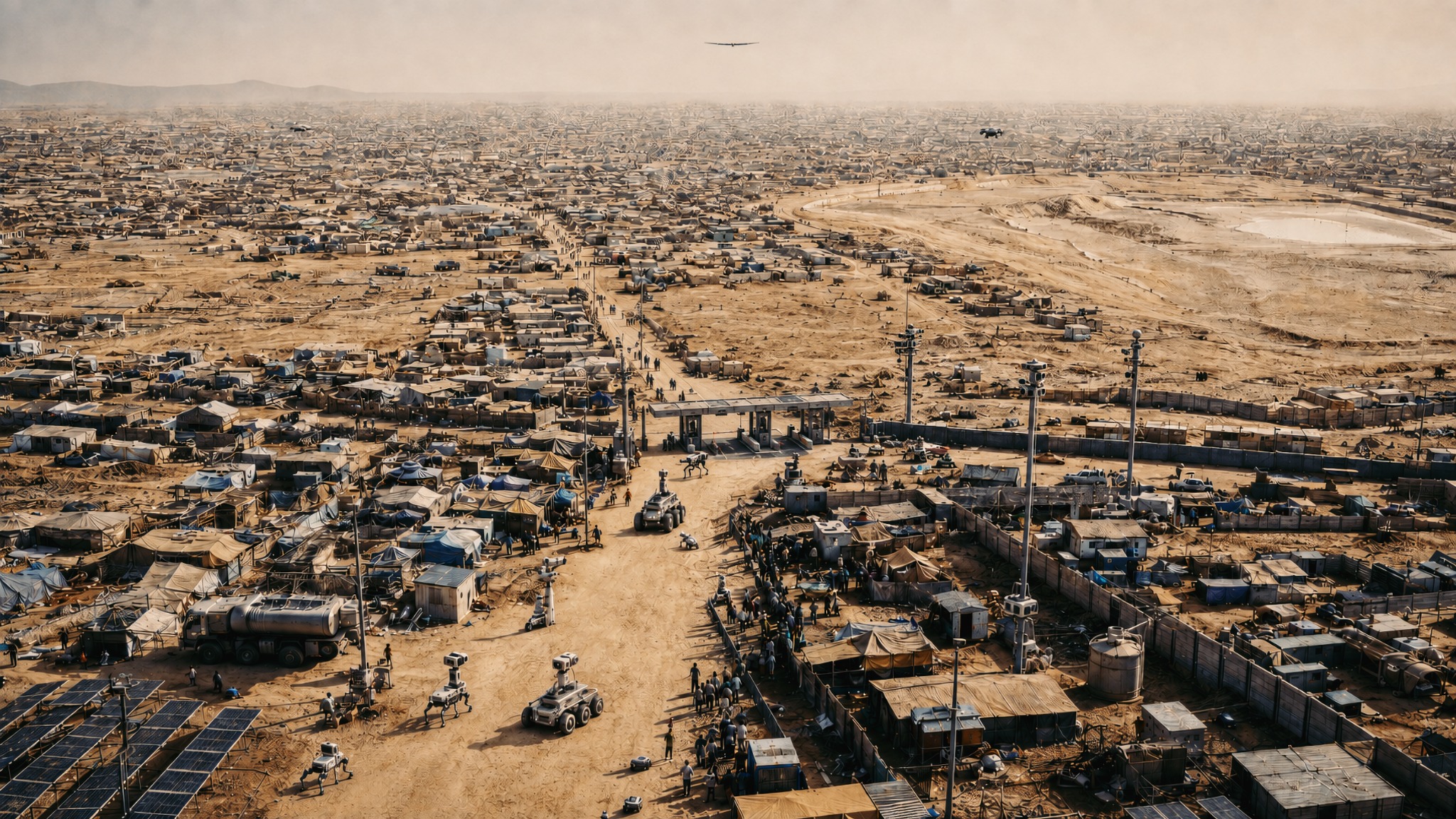
A vast migrant settlement stretches to the horizon in Algeria, near the Nigerien border. Across West and North Africa, the widespread use of surveillance robots and drones in camp cities only added to popular outrage.
Responding to popular pressure, governments demanded compensation for the impacts of droughts. A common target was the United States, which both led the SAI program in the Arctic and benefitted from continued oil and gas production. Ironically, the Indian government both demanded compensation and defended itself against claims for damages caused by the Indonesian SAI effort.
These claims multiplied. By 2075, politicians blamed every major drought on SAI efforts, even when AI models couldn’t firmly establish a relationship between those droughts and SAI programs. The argument was simple, and ultimately persuasive. Because the climate had been altered by geoengineering, popular politicians argued, extreme weather that occurred within that climate – especially drought, which climate models had already connected to SAI – was automatically a product of geoengineering.
The American government countered demands for compensation by pointing out that it had shouldered the majority of the cost – and provided most of the equipment and expertise – for the Arctic SAI program. If anything, it deserved to be paid for the estimated damage that would have occurred without geoengineering. And AI systems calculated that this damage would be in the tens of trillions of dollars, given current greenhouse gas concentrations.
When governments in drought-stricken countries continued to demand compensation, the governments most responsible for SAI efforts – led by the United States – repeatedly threatened to suspend their operations. Relations quickly soured between countries that were perceived to benefit from SAI and those that were viewed as suffering, and between countries that contributed to SAI efforts and those that didn’t.
The stage was set for the catastrophe that shattered the geoengineering experiment – and triggered warming unlike any in human history.
2075–2080: The Aerosol War
In 2075, threats by the United States to abandon the Arctic SAI program intimidated governments across Eurasia and Eastern Africa, where temperatures or precipitation would suddenly change if Atlantic ocean currents abruptly weakened. Many dropped their demands for compensation.
Their retreat only emboldened the Americans. The renewed growth of fossil fuel extraction and consumption had led to a widespread perception that the United States was again the world’s leading power, following an interval in which China seemed ascendant. Owing to the relationship between the circulation of the air and oceans, the American-led SAI effort also appeared to provide fewer benefits in North America than it did elsewhere.
The leverage provided by American power, on the one hand, and global circulation, on the other, seems to have convinced the American President – or the AI system advising the President – to demand back payments for nearly 25 years of geoengineering the Arctic. When governments refused to pay, the United States suspended drone flights for a week.
Frantic negotiations followed. Despite widespread and occasionally violent protests, many governments agreed to compensate the United States by purchasing vast quantities of American oil and liquefied natural gas, and investing trillions in US energy companies, pipelines, refineries, and petrochemical infrastructure.
The success of these negotiations – from the perspective of the US government – inspired a newly elected Indian government, led for the first time by the Aam Aadmi Party. India’s Prime Minister called for a second investment scheme that would both compensate India for its leadership of the Indonesian SAI effort, and pay for damages tied to the related weakening of the monsoon. To create leverage, in 2076 the Indian Air Force followed the American example by suspending its SAI operations, this time for two weeks.
Once again, governments responded with panic. But unlike in 2075, panic did not prompt negotiations or concessions.
China had long vied with India for influence across Asia. Its rapid demographic decline, prompted in part by the One Child Policy of the 1980s, 90s, and early 2000s, had weakened its position relative to both the United States and India. Now, the Chinese government perceived an opportunity to undermine India’s relationships with governments not just in Asia, but around the world.
China’s President announced that China would not accept blackmail that used the stability of the world’s climate as leverage. It announced that it would soon undertake its own SAI program from artificial airfields in the South China Sea. Chinese officials insinuated that an SAI effort was too expensive for India to maintain – but not for China.
The Chinese announcement seemed to improve China’s position in the court of global public opinion. Like the initial demands for compensation involving India, there was an irony in this development. China had long been accused of freeriding by not participating in SAI efforts. Now, it was widely perceived as the only superpower responsible enough to prioritize climate stability.
The Chinese announcement was not only deeply embarrassing for the Indian government and damaging to India’s global influence; it also threatened a key election promise by Aam Aadmi politicians. They had promised to use the leverage created by the Indonesian SAI program to secure massive foreign investments in Indian agriculture, not to mention direct cash transfers to low-income families who had struggled with high food prices. Now, it seemed they could not fulfill their promises. The era of Aam Aadmi dominance in Indian politics appeared to be ending almost before it could begin.
Believing it had no other options, the new Indian government threatened to intercept Chinese drones as they injected sulfur dioxide into the stratosphere. Indian officials did not believe that attacking uncrewed, autonomous drones would be perceived by their Chinese counterparts as an act of war. But China’s global prestige was now tightly bound to its promised SAI efforts.
When the Chinese SAI program began in early 2077, and the first Chinese drones were destroyed by Indian interceptors, nationalist protests swept across China. In the face of popular pressure and the prospect of global humiliation, China’s President announced that the Chinese Air Force would aggressively defend its SAI program – if necessary, by striking the airfields used by Indian interceptors.
It was the beginning of what commentators eventually called the Aerosol War. And it soon expanded beyond the worst fears of both Indian and Chinese officials.
For decades, the increasingly capable militaries of each superpower had prepared for war. As American influence receded from Asia in the late 2020s and 2030s, both the Indian and Chinese governments had constructed their own web of allies and dependents. Now, longstanding plans were put into practice. Aerial interceptions quickly escalated into long-range bombardment, border clashes, and finally all-out war between rival alliance systems.
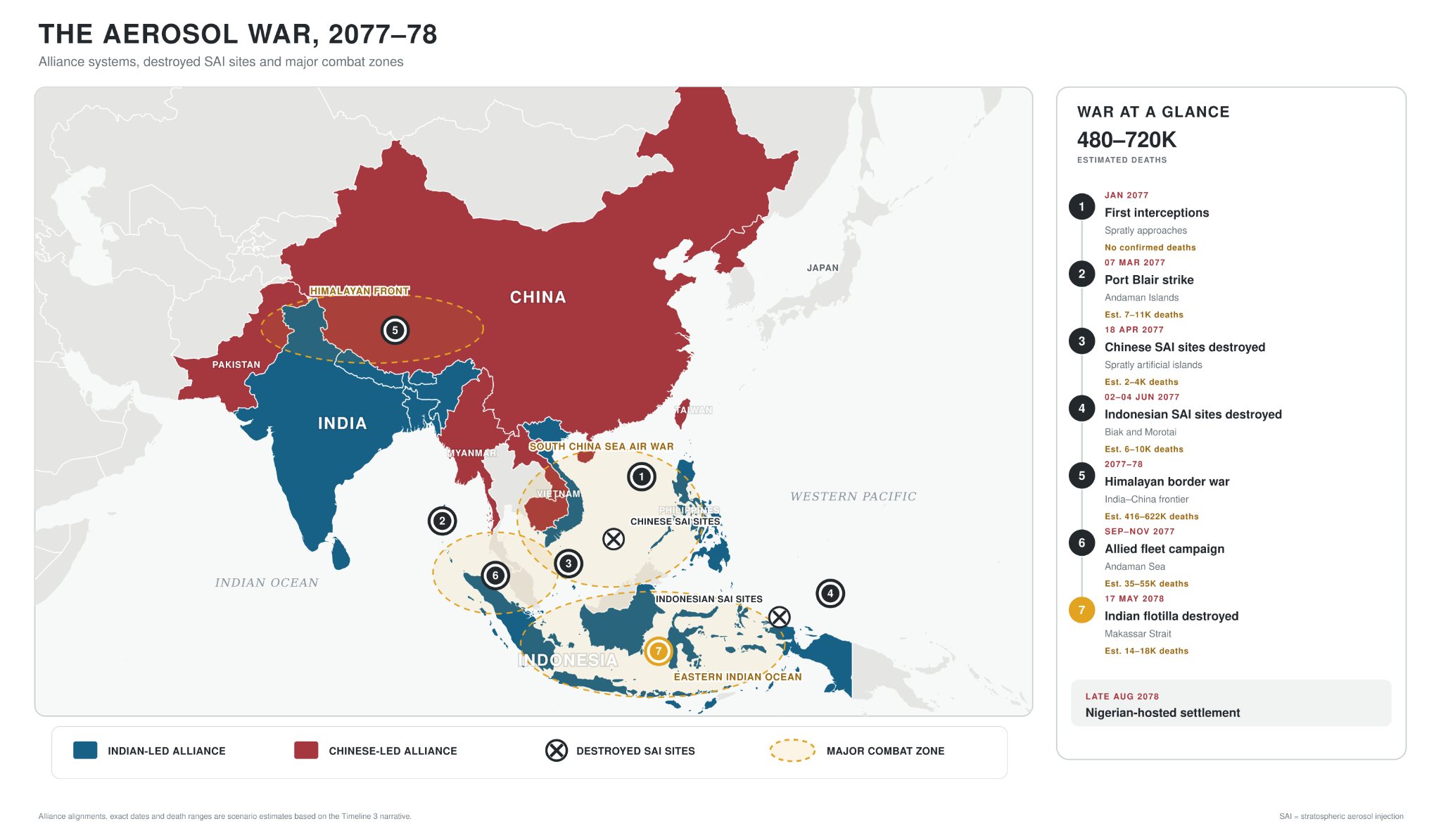
A map of the 2077-2078 Aerosol War, showing major battlefields and casualties. The war involved the widespread use of AI-controlled drone swarms in the air, at sea, on land, and in cyberspace. Not pictured: attacks in Earth orbit and the lunar surface.
To deprive India of any postwar leverage, the airfields and drones associated with the Indonesian SAI program were destroyed by Chinese bombers. Chinese airfields and drone infrastructure, meanwhile, were crippled by Indian bombers. For over a year, the war continued to escalate, with hundreds of thousands of casualties, until the destruction of an Indian flotilla raised the prospect of a nuclear exchange.
Owing in part to closely coordinated pressure by the American and Russian governments, the Chinese and Indian militaries stepped back from the brink. In late summer 2078, negotiations hosted by the Nigerian government culminated in an inconclusive settlement that, in some respects, restored the prewar status quo.
But the damage to the world’s geoengineering efforts was complete. It was not just that the infrastructure upholding the Asian SAI program – which had stabilized the temperature of the entire world – had been destroyed. It was that SAI seemed to have brought governments to the brink of nuclear war.
The risks of SAI now appeared to outweigh its benefits. Public opinion turned sharply against the remaining SAI program in the Arctic. Governments that had once paid the United States to continue the program now demanded it be cancelled.
In 2080 – the year I was born – NATO allies formally terminated their SAI efforts in the Arctic. And at COP85, governments resolved to abandon the 15°C global temperature target. Politicians announced that humanity would no longer play God with the world’s atmosphere.
It was a popular message. But at least some politicians must have known that it was too late to stop playing God.
Because atmospheric carbon dioxide concentrations now stood at 676 ppm.
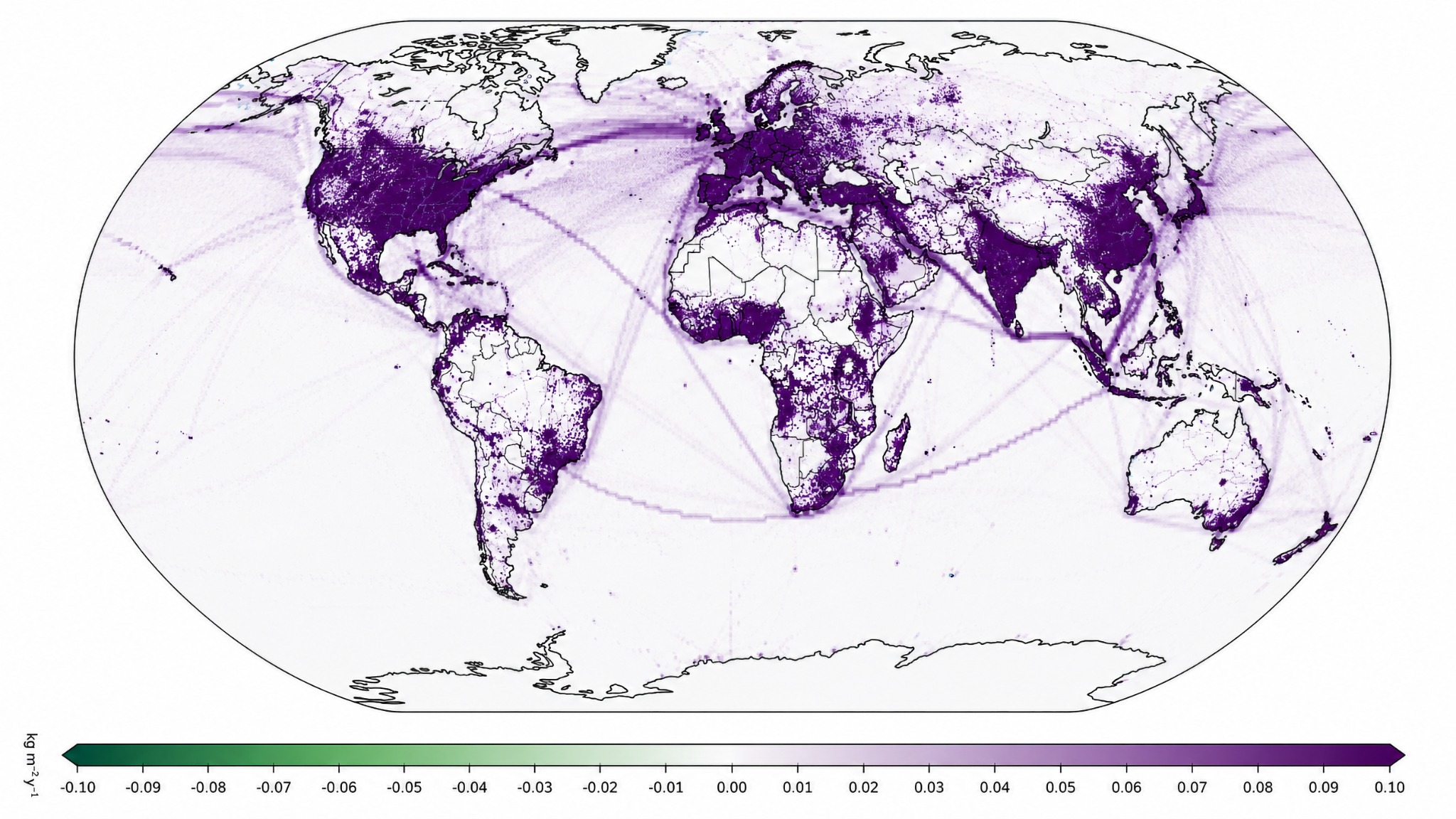
This map simulates atmospheric CO₂ in 2100 according to RCP 8.5. It is a modified version of an image obtainable from the IPCC WGI Interactive Atlas. Source: Intergovernmental Panel on Climate Change, “WGI Interactive Atlas,” accessed August 10, 2026.
2080–2100: The Termination Shock
By the end of 2080, AI monitoring systems determined that aerosol concentrations in the stratosphere were in rapid decline. The following year – 2081 – was the hottest in more than two decades. But it was nothing compared to the heat that awaited us.
In the following five years, global temperatures surged by nearly 1°C. That was as much as they had increased in the roughly 35 years preceding the Great Hunger of 2046.
I can’t imagine what it was like for my parents to have a child in those years. Because weather extremes are caused not just by the average temperature of the Earth but also by the rate at which the temperature changes, heatwaves, torrential rains, droughts, and storms were truly unprecedented in their severity and frequency.
Well beyond the tropics, and for weeks at a time, extreme combinations of heat and humidity pushed wet-bulb temperatures – a measure of how effectively sweat can cool the human body – to levels that made it impossible to survive for more than an hour or two. Like many cities, Jeddah became unlivable in the summer. Then, in 2084, harvests failed across all of the world’s breadbaskets, sending food prices to new highs. They failed again in the following year.
It’s impossible to overstate the magnitude of these disasters. By 2085, hundreds of millions may have died. It wasn’t just the famine. It was the heat itself. People without air conditioning simply couldn’t survive. And even where there was air conditioning, the electrical grid often couldn’t hold up.
Governments scrambled to respond. Trillions of dollars flowed into controlled-environment agriculture, including vast vertical farm complexes. Robots were able to build these complexes quickly, even in blistering weather, while AI systems developed even more capable, drought-resistant crops to grow outdoors.
The world’s food system briefly recovered. But, in 2088, measurements by satellites and ocean buoys confirmed that Atlantic Ocean currents were finally collapsing. Dramatic shifts in temperature and precipitation transformed the world’s breadbaskets, and profoundly reduced the amount of land on which staple crops could be grown. Even when spearheaded by AI systems with inhuman abilities, adaptation efforts could not compensate for the loss.
By 2094, governments around the world imposed draconian food rationing measures. Many limited meat consumption, restricted purchases of staple grains and cooking oil, and issued digital ration credits that capped how much families could buy each month. In most countries, the penalties for defying these edicts included death.
Human life, after all, seemed increasingly cheap.
Ecosystems across the tropics were now in headlong collapse. Forest fires raged on a continental scale, lofting vast plumes of carbon dioxide into the atmosphere. Methane – on short timescales, an even more potent greenhouse gas – surged out of the deep oceans and the melting permafrost.
A rapidly heating world created the mechanisms to heat itself ever faster, and faster.
The collapse of Atlantic Ocean currents reduced the northward flow of heat from the tropics, and that slowed the melting of the Greenland Ice Sheet. Yet the melting of the West Antarctic Ice Sheet accelerated until, in 2095, cliffs holding back the ice abruptly gave way. Vast quantities of ice, inconceivable in scale, rushed into the Southern Ocean. In just the last five years, sea levels have increased by 20 centimeters.
Climate models simulate that they will rise by another meter, at least, in the coming two decades. If the entire West Antarctic Ice Sheet melts – which now seems inevitable – sea levels will eventually climb by ten feet.
2100: A Doomed World?
Today, at the turn of the 22nd century, the world is defined by displacement.
Hundreds of millions, perhaps billions have died. It’s impossible to know exactly how many. And hundreds of millions more are on the move.
There is no future in the countryside, so they move to the city. There is no future along the coast, so they move inland. The trouble is that the cities are on the coast, while the countryside is inland.
So where do people go? For millions, the answer is grim. They go to their graves. There is no escape.
Except for the machines. They build where and when we no longer can. They construct greenhouses, vertical farms, and cities where life is still possible for most of the year. For now, at least, they build for us. But increasingly, they look like the future of life on this planet.
I hope that we can share in that future. But the prospects seem dim.
Looking back, geoengineering worked – for a time. It cooled the planet. It prevented immediate catastrophe. But it also changed how people thought.
Instead of reducing emissions, governments learned to tolerate them. Instead of solving global warming, they managed its symptoms. They built a system that required constant global cooperation, something history has rarely sustained.
When the system failed, everything failed with it.
Perhaps, in Saudi, we’ve come full circle. The wealth we gained from warming the Earth was consumed by warming.
The oil economy has finally collapsed. Many cities are uninhabitable. Towns in northern regions, far from the coast, have become refuges, not because they’re safe, but because they seem habitable. At least for part of the year.
My family moved north in 2091. We hoped it would be temporary.
It wasn’t.