Introduction: A World Transformed
I grew up in Mendoza, a green city in the middle of a desert.
That green wasn’t natural. Mendoza never received enough rain to support its vineyards, orchards, parks, and hundreds of thousands of roadside trees. It was an artificial oasis – one that took centuries to build.
The Indigenous Huarpes dug irrigation channels before the Spanish conquest. Settlers extended them into a sprawling network of canals and acequias: narrow channels running beside many streets. The acequias rerouted water from the Andes, transforming an unassuming patch of arid land into a haven for plants, animals – and people.
My grandparents tell me that, when they were children, this hydraulic system seemed almost miraculous.
Snow piled up high in the Andes during winter, then melted through spring and summer. The Mendoza River carried that water through the Potrerillos reservoir, into canals serving homes, farms, industries, and the urban forest. Plane trees and poplars entangled their branches above the streets, their shade cooling even the hottest summer days.
But by the time I was born, the miracle must have seemed like a distant memory.
Rapid warming meant that more winter precipitation had started to fall as rain, not snow. The snowline had retreated into the Andes, while the spring melt arrived earlier. Glaciers that once released water even during the driest years had lost much of their ice.
The Mendoza still flowed, but its seasonal rhythm had changed. More snowmelt arrived early in spring, leaving less water for long, hot summers, when farms and cities needed it most. Reservoirs held part of the early melt, but the water evaporated in summer heatwaves until little was left. Each drought forced the same argument: should remaining water go to households, vineyards, factories, wetlands – or the trees that made the city bearable?
Today, Earth is, on average, about 4 °C warmer than it was in the late 19th century.
Some still struggle with that number. It just can’t capture just how much Earth has changed. It hides how continents have warmed much more than water, how the far north has warmed more than lower latitudes – or how days, weeks, and entire seasons can reach temperatures unimaginable before our century.
Earth is a fundamentally different planet than the one my grandparents knew. A planet that is no longer a safe home for humanity.
This outcome was not inevitable.
Our world emerged from choices made by powerful governments, corporations, and elites. Because of their decisions, fossil-fueled power plants and cars accumulated faster than clean energy alternatives could replace them. Forests and soils were left to deteriorate.
Repeated crises fractured multilateral institutions and the very spirit of international cooperation. Each disaster led governments to hoard their own resources, rather than cooperate to confront a common threat.
The century has not ended in human extinction. Billions of people remain alive. Many cities still function. But societies have become poorer, more coercive, and more divided. Billions have died in catastrophes that AI systems link, directly or indirectly, to climate change. Hundreds of millions more are displaced.
Governments have normalized emergency powers, rationing, fortified borders, and the forced abandonment of places judged too expensive to protect. In many of the world’s biggest cities, outdoor life disappears for much of the summer. People wander through vast, underground corridors between sealed buildings, cooled by air conditioning systems hooked to redundant power grids.
This is the history of how global warming diminished our planet and crippled our civilization.
Not because no one understood the danger. Because those powerful enough to safeguard our future cared more about enriching themselves in their present.
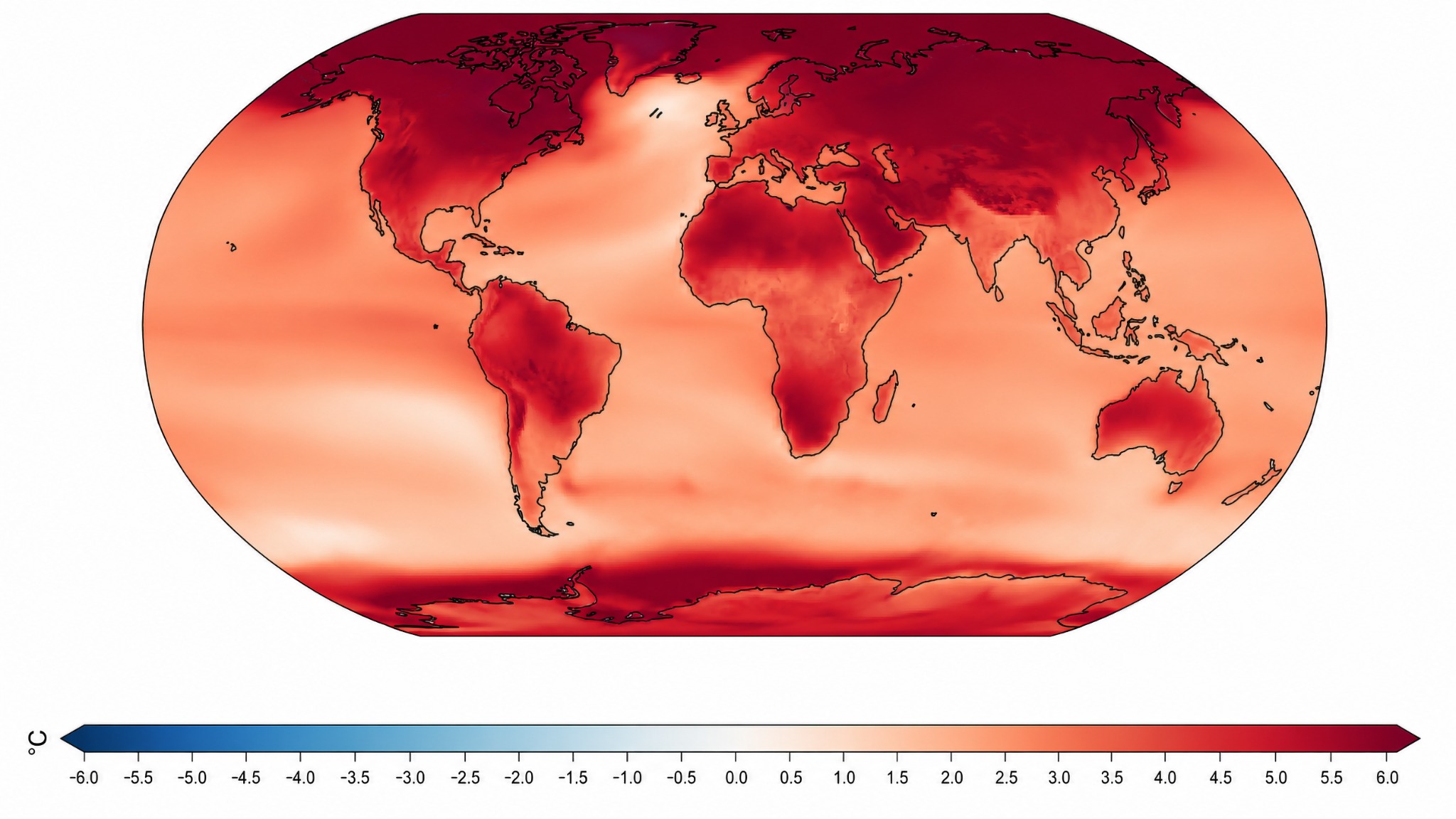
This map simulates regional temperature change when Earth has warmed by 4 °C, relative to its average temperature in the late nineteenth century. It is a modified version of an image obtainable from the IPCC WGI Interactive Atlas. Source: Intergovernmental Panel on Climate Change, “WGI Interactive Atlas,” accessed August 10, 2026.
2044-2053: The Great Hunger Dooms Climate Action
The multiple breadbasket failure of 2044-46 was a turning point. But not as climate activists had hoped.
As a severe El Niño amplified the effects of global warming, extreme heat, drought, and flooding simultaneously struck the world’s major food-producing regions. Decades of unsustainable groundwater exploitation and, in some places, disruptions caused by war meant that the consequences were even more severe than they might have been.
A century of globalization made the global food system efficient but brittle. Internationally traded wheat, maize, rice, and soy harvests came from a handful of places where soils, climates, farms, transportation networks, and government subsidies combined to make it easy to grow and move food. Grain reserves were kept low to reduce costs, and governments assumed that markets would always move food from surplus to shortage.
But during the Great Hunger, many of the world’s largest food exporters restricted sales at the same time. Governments that could pay bought what remained; governments that couldn’t pay were powerless as their citizens went hungry.
Argentina was among the hardest hit countries. Farm products and food accounted for more than half of its export income. But from 2044 to 2045, record heat gave way to weeks of torrential rain, as hot water across the tropical Pacific directed more and more moisture toward southeastern South America.
Floods and waterlogged fields cut soy and maize production across the Pampas, and damaged the wheat harvest. The swollen Paraná disrupted navigation and severed road and rail links to grain terminals around Rosario, delaying exports for weeks.
Revenues from exports collapsed just as the price of bread, cooking oil, animal feed, and imported machinery rose. It was a perfect storm. Inflation accelerated, rural employment slumped, and governments lurched between export taxes, price controls, and emergency subsidies.
Each measure protected one group, while shifting losses to another.
The aftermath of the crisis also exposed a glaring contradiction in the clean-energy economy. It began when El Niño conditions gave way to a strong La Niña event that cooled the waters of the tropical Pacific, even as the world warmed. Colder water evaporates less easily and heats the air above it less strongly. Atmospheric circulation changed, bringing less rain to parts of South America.
Now, lithium extracted from salt flats in northwestern Argentina was essential to the batteries that powered the green economy. But this extraction was altering water flows in some of the driest landscapes on Earth. Mining companies pumped briny, mineral-rich water from beneath salt flats. They used precious freshwater to separate lithium from other salts, clean equipment, and supply workers’ camps.
Indigenous leaders warned that surface pools, wetlands, grazing lands, and freshwater aquifers were connected in ways monitoring programs couldn’t see. Locals complained that foreign companies were draining water from one of Argentina’s poorest regions to fuel the insatiable energy demands of the world’s richest countries and companies. Corporate and government officials responded by insisting that lithium extraction permitted a global transition away from fossil fuels – which, in a roundabout way, benefited everyone in Argentina.
Amid severe droughts, protests around three of Argentina’s most important lithium mines turned deadly in 2048 and 2049. Worldwide media attention deepened distrust of renewable energy and the green economy not just in Argentina, but around the world.
By then, renewable electricity had expanded for decades. Solar panels, wind turbines, batteries, heat pumps, and electric vehicles prevented some warming than would otherwise have occurred. But there hadn’t been an energy transition away from fossil fuels, but rather an energy addition. Renewables met soaring electricity demand from data centers and continued economic development across Asia and Africa; they didn’t replace the energy generated by fossil fuels.
Oil and gas still powered a large share of energy production, not to mention most aviation and shipping. Fossil fuels supplied petrochemicals and high-temperature industrial heat, and remained essential to farming. Every year, tens of billions of tons of carbon dioxide and other greenhouse gases continued to pollute the atmosphere.
The 2046 famine was called a betrayal by environmental activists because it wouldn’t have happened had governments acted to stop global warming. But others called it a betrayal because it revealed avoidable shortcomings in the world’s food system that had nothing to do with climate. Many argued that the famine had little relation to climate – El Niño, after all, had always occurred – and polling revealed that a plurality of the public adopted this view in many of the world’s largest economies.
Ironically, the Great Hunger fueled a backlash against climate action. To prevent another subsistence crisis, governments subsidized diesel for tractors and trucks, reopened coal plants to lower electricity prices, and signed new contracts for oil and liquefied natural gas.
Then, in 2048, a crisis in Nigeria – a country where large majorities still believed that the world was warming and that action was urgently needed – doomed global efforts to cut emissions.
After the Great Hunger, Nigeria’s government responded to popular pressure by ending fuel subsidies and canceling new oil and gas projects. Petrol prices soared, making food and transport still more expensive, and leaving many households and businesses unable to run the generators they relied on during power cuts. There wasn’t enough renewable electricity, public transit, or support for displaced workers, so the country slid into a severe recession.
High food prices roiled communities that had been traumatized by the Great Hunger. Mass protests quickly metastasized into a bloody uprising that, after weeks of violence, culminated in a military coup.
Across the Global South, officials used the crisis to argue that calls for decarbonization amounted to a new form of colonialism – one that could let wealthy countries slow the growth of potential competitors and control their governments. And in the Global North, politicians argued that decarbonization would be pointless if it didn’t involve rapidly growing economies in Africa, South America, and South Asia. Many governments abandoned longstanding pledges to limit greenhouse gas emissions.
The collapse of efforts to cut those emissions led some governments to approve geoengineering experiments. Geoengineering refers to an intentional intervention in Earth’s climate system that counteracts global warming.
In 2049 and 2050, the governments of Sweden and Japan approved three large-scale geoengineering demonstrations that used huge, high-altitude balloons to release sulfur compounds into the stratosphere. As climate models had predicted, these compounds formed tiny reflective particles, known as aerosols, that cooled the lower atmosphere by scattering incoming sunlight.
But the tests needed to create a lot of aerosols to generate measurable cooling, and their scale helped spark widespread popular opposition. The Great Hunger had led to a collapse in public trust in government, even in wealthy countries where it had led to severe inflation, rather than food shortages. Few now believed that governments could successfully manage a global climate modification program, and popular conspiracy theories even blamed secret geoengineering experiments for the famine.
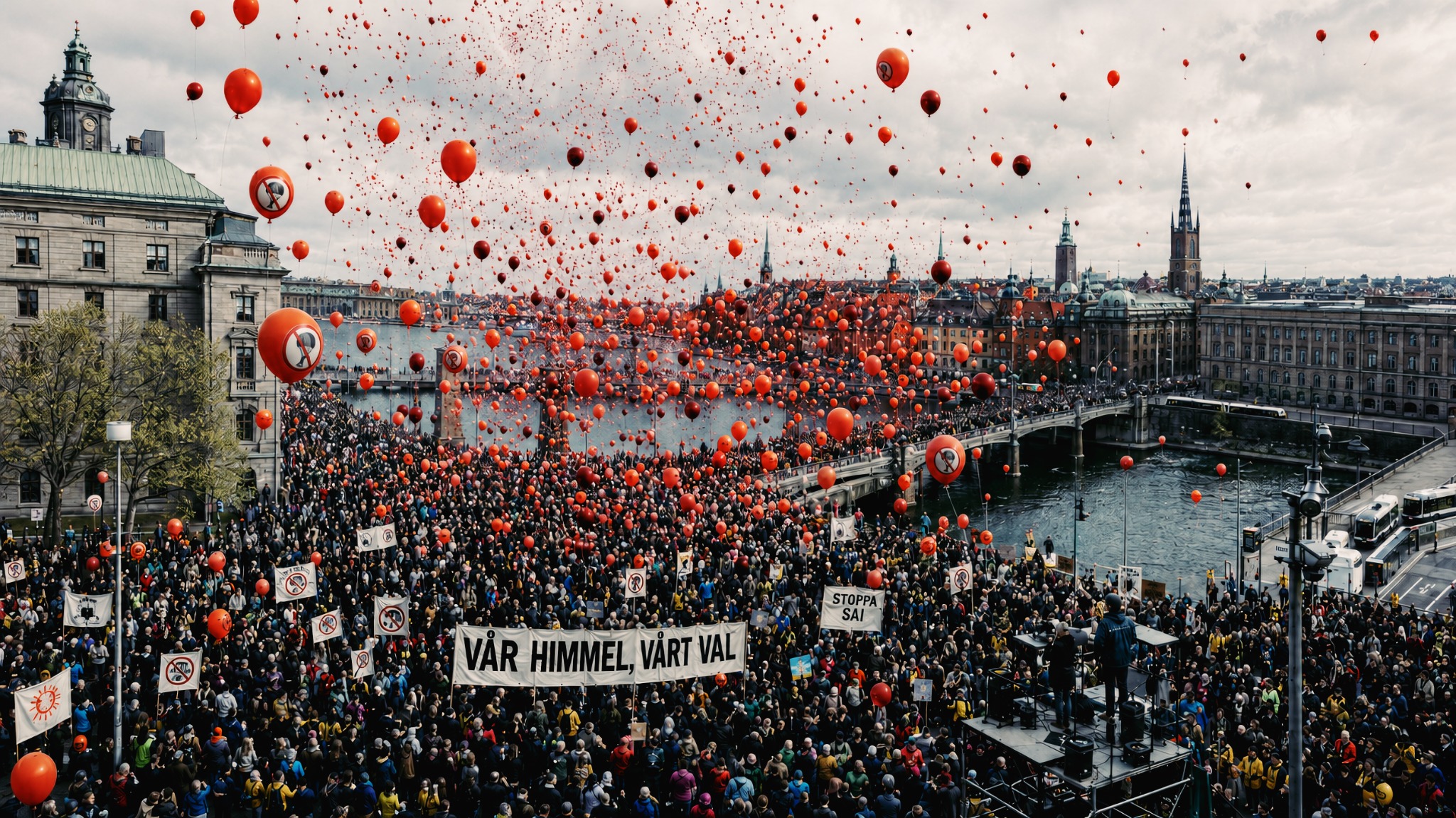
An anti-geoengineering protest in Stockholm. Inspired by the high-altitude balloons used to release aerosols over Japan and Sweden, protestors released thousands of red balloons - the red symbolizing the bloodshed some thought a geoengineering program could cause.
In a sense, the public was right. Tentative efforts by a handful of countries to create a UN resolution on geoengineering soon revealed that there were simply too many questions that governments couldn’t answer. For example: who would control the aircraft and decide the target temperature? How would governments determine whether a drought or flood had been influenced by the intervention? Who – or what – would compensate countries harmed by changes they had not approved?
It surprised no one that the same international order that had failed to cut greenhouse gas emissions could not decide how to dim the Sun.
2053-2062: The Marine Food Crisis
The next great food shock began at sea.
Historians have described 2053 as the year the world's fisheries collapsed. The phrase is memorable, though perhaps misleading. Fish didn’t disappear everywhere at once. Instead, warming, overfishing, acidification, oxygen loss, habitat destruction, and political conflict all combined to produce a rolling series of regional failures that the global market could no longer absorb.
Off Peru, a poor anchovy season in 2053, connected to warming supercharged by another strong El Niño, drove up the price of fishmeal used to feed farmed fish. Meanwhile, in the western Pacific, disputes over fishing fees led island governments to bar foreign tuna fleets from unloading at ports such as Majuro and Tarawa. Off northern Greece, marine heatwaves killed millions of mussels across the Thermaic Gulf.
Increasingly, the consequences of regional shortfalls in marine harvests reinforced one another.
For decades, the oceans had absorbed most of the excess heat trapped by greenhouse gases. Marine heatwaves had become longer, more intense, and more extensive, pushing many species toward the poles or into deeper water. Tropical countries generally lost potential catch while some high-latitude fisheries temporarily gained unfamiliar species.
As warming waters drove valuable fish populations from one country’s waters into another’s, fishing agreements became outdated. Governments increasingly disputed who could catch the fish, and how many they could catch. Illegal fishing expanded as governments struggled to patrol larger and more contested waters.
Ocean acidification added still more pressure to fish stocks. When carbon dioxide dissolves in seawater, it changes the water's chemistry and reduces the carbonate ions used by corals, oysters, clams, sea snails, and some plankton to build shells and skeletons.
Warm-water coral reefs suffered most visibly.
Repeated marine heat waves caused bleaching by forcing corals to expel the algae that supplied most of their energy. When the heat persisted, or returned too frequently, colonies died faster than reefs could recover. Ocean acidification then made it harder for surviving corals to build their skeletons, while increasingly powerful storms shattered reef structures that had taken centuries to form.
By the 2060s, most tropical reefs no longer functioned as the complex three-dimensional ecosystems that had sheltered juvenile fish, weakened waves, supported tourism, and sustained coastal cultures. Only small corals clung to life in cooler refuges, deeper water, and places with strong currents.
Overall, the world’s marine catch had now fallen by roughly a third from early-century levels. That average concealed even more severe losses in tropical and enclosed seas.
In many coastal communities, fishing provided not only essential nutrients and meaningful work, but also a sense of continuity between generations. Unique fishing cultures now began to unravel, even as malnutrition swept across poor communities that had depended on fish for protein.
Wealthier consumers shifted toward expensive aquaculture, or imports from the remaining productive waters. Once again, those most responsible for the crisis suffered least.
2058-2075: Disappearing Ice, Rising Seas
In 2058, satellites began to measure an abrupt acceleration in ice loss from West Antarctica.
Several of the continent’s vast glaciers rested on the ocean floor. As the edges of these glaciers retreated, they reached places where the bottom of the ocean sloped downwards, opening a space for warming seawater to penetrate beneath the glaciers. The water began to melt the glaciers from below, even as warm air temperatures melted them from above. Dark water pooled on the surface of the glaciers, absorbing more sunlight than the bright ice and intensifying the melt.
Warmed from above and below, Antarctic glaciers retreated with accelerating speed. And because the process had become self-sustaining, it was irreversible on human timescales.
Sea-level rise accelerated through the second half of the century. Thermal expansion – the tendency of seawater to occupy more volume as it warms – accounted for part of the rise. But an increasing share came from meltwater flowing off mountain glaciers, and icebergs calving from the ice sheets of Greenland and Antarctica.
By 2100, average global sea levels were some five feet higher than they had been a century earlier. In many places – where land was sinking or rising; where currents were shifting; or where the gravitational pull of shrinking ice sheets was changing – the sea was lower, or even higher, than the global average.
Some places vanished quickly, in storms that shattered defenses against the sea and established a new coast. In 2075, for example, a catastrophic storm broke through the Delta Works, a vast system of dams, storm surge barriers, and dikes that had protected the low-lying Netherlands from the sea. Flooding spread so quickly and on such a scale that, within about 48 hours, some 90,000 people had died.
Millions fled to higher ground, rebuilding as best they could. But the inundated cities could never be resettled. The economy of the Netherlands was in ruins. The country’s unique cultural heritage – its art, dairy farms, tulip fields, and polders –was irretrievably lost. And worse, the identity of the Dutch, their sense of fairness and equality, their pride in a country that had been made more than found, seemed like it too had vanished beneath the waves.
Most coastal cities didn’t disappear all at once. Still, vast swathes of Alexandria, Bangkok, Chittagong, Dhaka, Miami, Shanghai, Venice, and many other cities, were soon too expensive to defend from the sea. Historic centers, ports, and financial districts survived where municipal, regional, and national governments cooperated to build surge barriers and pumps, to raise roads, or to restore wetlands. Elsewhere, insurance disappeared, mortgages shortened, drinking-water aquifers turned salty, and repeated floods made ordinary maintenance impossible.
The phrase “submerged city” became shorthand for a complicated, dystopian reality: a place still visible on maps, but losing homes, tax revenue, transport links, and confidence year by year.
To people in Mendoza and other desert cities, disappearing ice carried the opposite meaning. Water wasn’t surging into our streets; it was disappearing into the mountains.
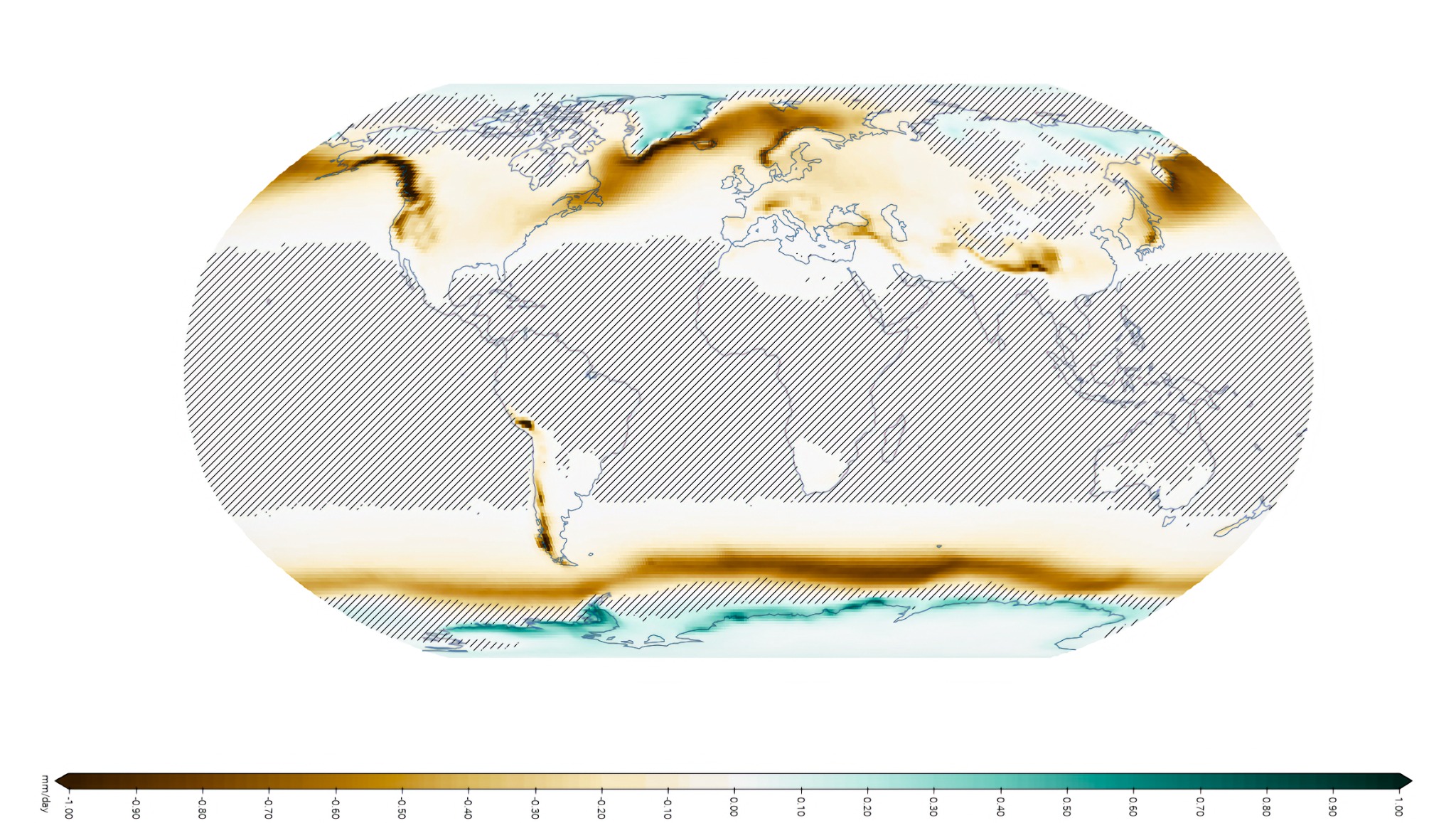
This map simulates where snowfall increases and declines in 2100 when Earth has warmed by 4 °C, under scenario SSP5-8.5. It is a modified version of an image obtainable from the IPCC WGI Interactive Atlas. Source: Intergovernmental Panel on Climate Change, “WGI Interactive Atlas,” accessed August 10, 2026.
Granted, melting snow and rain supplied most of the Mendoza River’s water. But glaciers had provided the rest. The glaciers mattered most when there wasn’t much snow or rain – during La Niña events, for example.
At first, glacial melting actually increased the water in the Mendoza River. Then the glaciers passed peak water: the point at which they had declined to such an extent that they could no longer supply as much meltwater. Finally, by the end of the century, Southern Andean glaciers were too diminished to provide protection during multiyear droughts.
With support from Argentina’s government, Mendoza tried to make every liter last longer.
Engineers enlarged storage basins away from the rivers so they could capture water during brief periods of abundant snowmelt, then release it during dry months. They covered canals and repaired leaking gates so that less water disappeared before reaching farms. Drip irrigation delivered water directly to plant roots. Treated wastewater irrigated crops and parks. Satellites and meters helped officials identify wells that were pumping more groundwater than permitted.
But efficiency couldn’t create new water. And it tended to cause fresh problems.
Savings in one vineyard spurred new development elsewhere. Sealed canals reduced seepage that had helped recharge aquifers or sustain vegetation downstream. It felt like every success in water management created a new source of conflict – or a new environmental crisis.
My grandmother worked for the provincial water authority. When I was nine years old, she took me to the Potrerillos reservoir. I remember her pointing to pale bands of rock, layered above the waves. They marked where water had once stood.
Her lesson was simple enough for a child to understand. Mendoza was a diminished place, because the Earth’s climate had changed. From now on, it would be harder for us to survive.
2060-2078: Arctic Destabilization
The Arctic warmed much faster than the planet as a whole.
Snow and sea ice reflect most of the sunlight that reaches them, and that cools their surroundings. But as the Arctic warmed, retreating snow and ice exposed more and more land and ocean, which were darker and reflected less sunlight. So, exposed land and water warmed the Arctic, melting still more snow and ice.
It was just one of several feedback loops that led the Arctic to heat up so quickly.
By the 2050s, the Arctic Ocean was nearly ice-free at the end of summer – at least in most years. Winter sea ice didn’t disappear, but it became thinner, younger, and more mobile.
At first, some governments and corporations welcomed the retreat of Arctic sea ice.
It allowed oil companies to access previously unreachable oil and gas reserves, though it also strengthened storms that made those reserves dangerous to exploit. More importantly, it created new shipping opportunities. The Northern Sea Route above Russia and the passages through the islands of the Canadian Arctic shortened ship voyages between the Atlantic and Pacific, and kept them away from pirates or militants in the Middle East.
But sea ice remained dangerous even when it covered less area, and broken floes moved unpredictably. Fog, limited ports and rescue capacity, and powerful waves unlocked by the retreat of sea ice all raised shipping costs. Meanwhile, the loss of ice that had protected shorelines allowed storms to damage villages, fuel depots, and docks.
Geopolitical competition made the region even less attractive to shipping and oil companies. Russia, Canada, Denmark through Greenland, Norway, and the United States disputed navigation rules, military access, seabed resources, and responsibility for spills. The Bering Strait – the narrow entrance between the Pacific and Arctic oceans – became a strategic chokepoint. Collisions, sabotage, and military confrontations raised the risk of a major war between nuclear superpowers.
Many of the most destructive changes to Arctic environments unfolded on land. Permafrost had stored vast quantities of underground ice. When that ice melted, the ground above it sagged, or collapsed to form sinkholes and even lakes. Roads buckled, building foundations cracked, pipelines shifted, and runways became unsafe.
Repairs often failed because engineers tried to rebuild on unstable ground. Indigenous communities that had contributed almost nothing to global warming lost travel routes, ice cellars, homes, burial grounds, and sacred landscapes. Relocation programs could move buildings and residents, but money couldn’t reproduce a coastline, a hunting route, or knowledge rooted in a particular place.
Frozen soils also stored roughly twice as much carbon as the preindustrial atmosphere. Most of that carbon has remained underground – for now – but thawing has exposed ancient plant and animal remains to microbes, which by consuming organic matter released carbon dioxide. In waterlogged soils with little oxygen, other microbes produced methane instead. Methane is a greenhouse gas that warms the Earth even more than carbon dioxide, but it doesn’t stay in the atmosphere as long.
Permafrost emissions supercharged Arctic warming, which in turn led to even more melting, then more emissions. But because they came from natural sources and affected a sparsely populated part of the world, they were politically easy for national governments to ignore.
Boreal forests added another feedback loop. Hotter, drier summers sparked increasingly severe fires across Canada, Alaska, Scandinavia, and Siberia that couldn’t be contained even with new, robotic forest management and firefighting systems. Many northern landscapes did grow more vegetation as temperatures and atmospheric carbon dioxide concentrations rose. But drought and fire often killed mature trees faster than new forests could establish.
Fires released carbon and burned the insulating organic layer above permafrost. Smoke crossed oceans and continents, darkened snow, worsened heart and lung disease, interrupted aviation, and turned summer skies a sickly orange from Toronto to Beijing.
By the 2070s, populations across the Northern Hemisphere regarded suffocating wildfire smoke and evacuations from forested areas as normal parts of summer weather. The impacts of wildfires on economic output seemed manageable, so governments mandated new air filters – or passed legislation to limit outdoor work and rebuilding in woodlands – rather than reducing emissions.
2078-2100: The AMOC Shock
The climate event that most profoundly reshaped the Earth began in the North Atlantic.
In the early 2070s, a vast system of currents, known as the Atlantic Meridional Overturning Circulation (AMOC), still pushed warm water from the tropics to the northern reaches of the Atlantic Ocean. Evaporation at the surface of the ocean made this water especially salty, and its salt content made it heavier than surrounding water. In the North Atlantic, it cooled, sank, and returned south.
The formation of this “deep water” depended on temperature and salinity. That made it exquisitely sensitive to warming, shifts in rainfall, and meltwater cascading off the Greenland Ice Sheet.
Scientists in the early 21st century agreed that the AMOC would weaken, but debated how much it could slow before 2100. Computer models simulated that a severe weakening – let alone a shutdown – was unlikely even under extreme warming.
But other studies detected troubling signs that a tipping point could be just years away.
In 2078, instruments moored to the ocean floor measured an abrupt and unexpected decline in the strength of the AMOC. The currents didn’t disappear completely, but within a decade they had weakened to such an extent that many scientists claimed they had, essentially, collapsed.
The consequences of this Ocean Breakdown, as people called it, intensified around the time I was born.
The AMOC had moved heat north from the equator, and westerly winds directed by Earth’s rotation carried that heat over Europe. The sun warms Europe’s land in the summer, so the effect didn’t matter as much then. But in the winter, heat from the ocean kept European temperatures much warmer than those of North America at the same latitude.
Not anymore.
Summers across Europe kept heating up, but winters in the continent’s north and northwest cooled down with shocking speed. In one week during the winter of 2089, temperatures plummeted to -13 °C in London, and -34 °C in Stockholm – not accounting for the wind chill. Now, energy systems had to prepare for heating emergencies and heatwaves in the same year.
Across vast stretches of the North Atlantic and European Arctic, sea ice began to expand and survive the summer melt. Oil rigs established above northern reserves were hastily relocated. Parts of the Northern Sea Route above Russia were again closed to shipping. Even some sections of the Greenland Ice Sheet stabilized.
The distribution of North Atlantic plankton and fish communities shifted, damaging fisheries around Iceland, Greenland, and western Europe. Across the northern fringes of Siberia, the ground stopped thawing, hardening a scarred and pockmarked landscape.
But the worst consequences of the Ocean Breakdown were felt far from the North Atlantic.
Rain belts and storm tracks shifted because currents in the Atlantic organized winds that blew far beyond the ocean itself. The West African and South Asian monsoons failed in some years, and moved in others. Beginning in the 2080s, droughts reminiscent of the Great Hunger repeatedly devastated food production across China, the Indian subcontinent, and the Sahel.
Widespread malnutrition set the stage for increasingly deadly outbreaks of epidemic disease.
The bacteria and viruses responsible for diseases such as dengue and cholera, which had killed millions in the previous century, caused some of these outbreaks. But more and more involved previously unknown microorganisms crossing over from animal hosts to people. AI systems connected these spillovers to the collapse of ecosystems, which had changed where many animals lived, and how many there were.
New respiratory diseases spread the most quickly, and killed the most people. Several emerged simultaneously in different parts of the world. The interaction of different diseases in malnourished and displaced communities led to tens of millions of deaths, every year.
Meanwhile, sea levels rose rapidly along parts of the North American east coast, because weaker currents caused water to pile up when it otherwise would have flowed north. Heat pooled around the tropics, worsening marine heat waves.
Rainfall increased across the southern and eastern Amazon basin, preserving or restoring parts of the rainforest. But South America’s northern edge dried out.
After the Breakdown, farmers abandoned maize and wheat cultivation across parts of Eurasia as colder growing seasons and summer drying made harvests increasingly unreliable.
But AI systems had supercharged the development of genetically modified organisms, and extreme heat and drought had already spurred investment into climate-controlled agriculture. Food production declined in many regions, pushing up inflation and worsening malnutrition in poor communities.
Europe remained wealthy, technologically advanced, and home to hundreds of millions of people. But birthrates in many European countries had long been among the world’s lowest. Now, migration to other continents, or from northern to southern Europe, accelerated the decline of neighborhoods and cities across Europe.
Across Europe, tourists visited deserted buildings and suburbs, as they once had in America’s rust belt.
2086-2095: The Water Emergency and Political Fracture
By the 2080s, more and more communities struggled with water insecurity. There wasn’t enough water – except when there was far too much of it.
Higher temperatures increased evaporation from soils and reservoirs, and parched crops required more moisture. Snowpacks melted earlier, while glaciers that had once released water during dry seasons had shrunk. Saltwater seeped into coastal aquifers, and deteriorating or overburdened electrical grids made pumping, treatment, and desalination less reliable. Rain increasingly fell in torrential downpours.
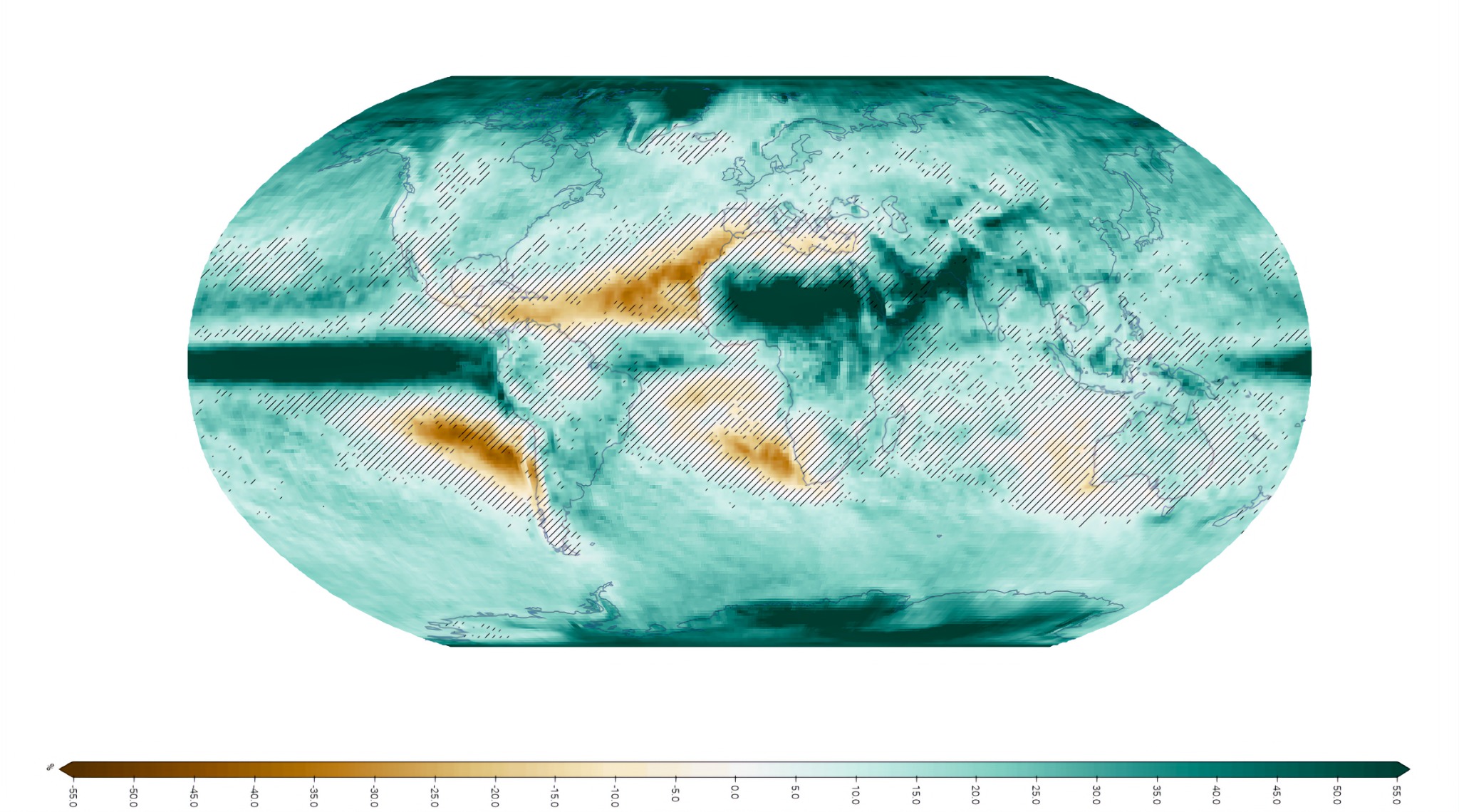
This map simulates changes in maximum five-day precipitation in 2100 when Earth has warmed by 4 °C, under scenario SSP5-8.5. The baseline is 1850–1900. It is a modified version of an image obtainable from the IPCC WGI Interactive Atlas. Source: Intergovernmental Panel on Climate Change, “WGI Interactive Atlas,” accessed August 10, 2026.
In Mendoza, the emergency arrived as a sequence of water allocation orders. The government formally prioritized drinking water, but cities, farms, wineries, mines, hydropower stations, and ecosystems all depended on the same rivers and aquifers.
Agriculture had historically used most of the province's developed water, so even small urban shortages spurred demands for large cuts to irrigation. Farmers replied that turning off a household tap for an hour was temporary, but withholding water from a mature vineyard could destroy decades of work. Nevertheless, provincial officials shortened irrigation seasons, paid growers to remove vines, prohibited new wells in exhausted aquifers, and purchased some old water rights for transfer to towns.
The oasis changed crop by crop. Wine grapes tolerated dry conditions better than many fruits, but extreme heat accelerated ripening, raised sugar faster than flavor developed, lowered acidity, and scorched exposed berries. Growers shifted vineyards to higher elevations, farther south, or toward varieties better suited to hotter conditions.
Wealthy estates installed shade cloth, sensors, efficient irrigation, and cooling equipment. Small producers sold land or stopped farming. The wine industry survived, but it wasn’t the same. The wine-growing region moved and shriveled, leaving abandoned irrigation ditches, deserted towns, and ruined livelihoods in its wake.
And the municipal government had to decide how much of its urban forest it could still support. At the beginning of the century, roughly 1,000 kilometers of acequias watered more than 600,000 trees across Mendoza. Their shade reduced the electricity needed for cooling.
Cutting irrigation would save water, while increasing heat deaths. Authorities did their best to replace thirsty plane trees and poplars with native molles, algarrobos, and other drought-tolerant species. But a young desert tree couldn’t immediately reproduce the deep shade of an eighty-year-old canopy. Blocks that lost mature trees became hotter before the new landscape could grow.
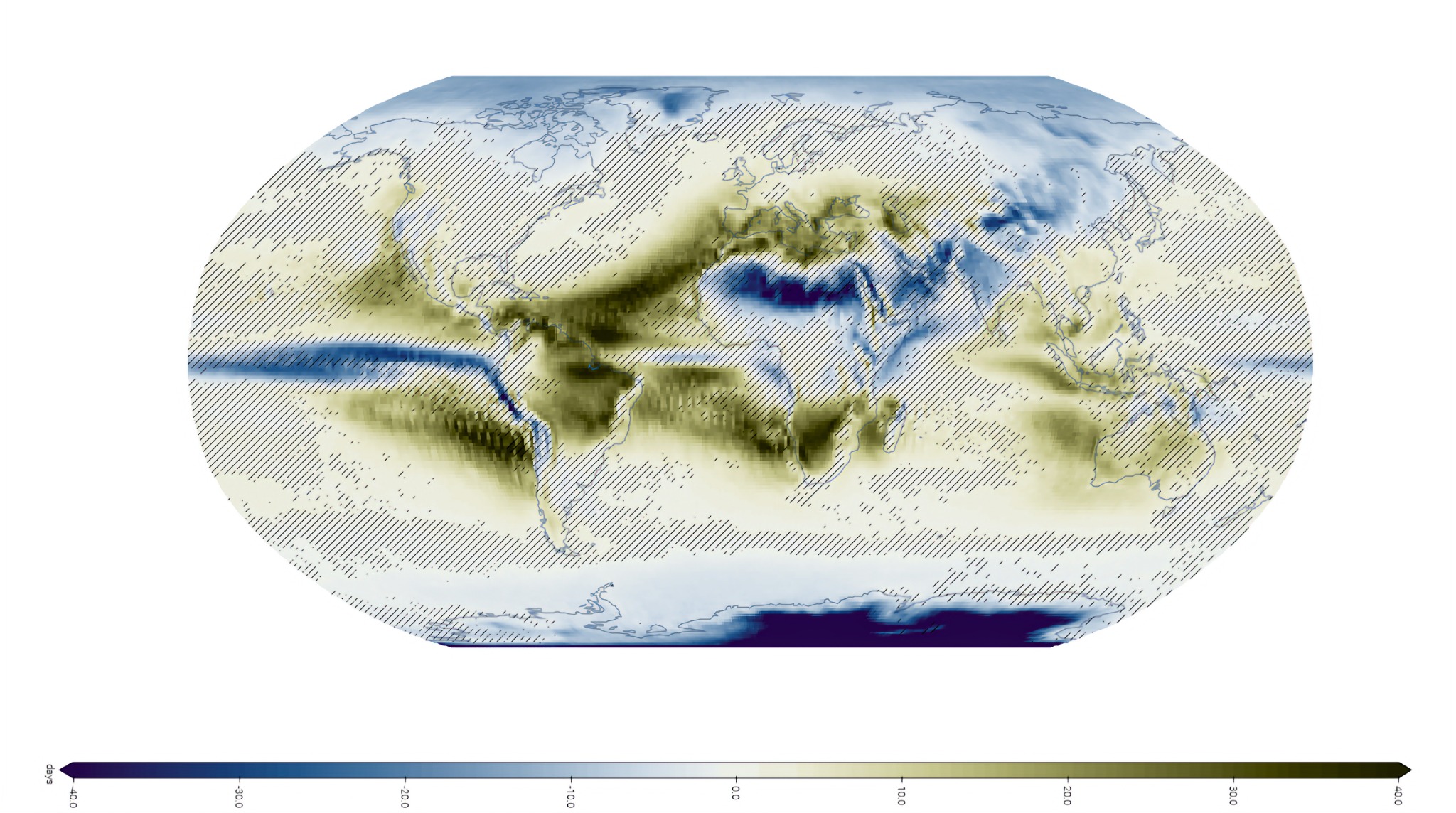
This map simulates changes in consecutive dry days when Earth has warmed by 4 °C, under scenario SSP5-8.5. The baseline is 1850–1900. It is a modified version of an image obtainable from the IPCC WGI Interactive Atlas. Source: Intergovernmental Panel on Climate Change, “WGI Interactive Atlas,” accessed August 10, 2026.
Around the world, water sparked conflict. The stakes were especially high where rivers crossed borders.
During a severe drought in 2088, for example, China filled emergency reservoirs and expanded diversions in the upper Mekong and the Yarlung Tsangpo-Brahmaputra basin. That reduced or delayed downstream flows just as Vietnam, Laos, Cambodia, Thailand, India, and Bangladesh needed water most.
Diplomatic pressure, cyberattacks on dam controls, and military deployments followed. Along the disputed Himalayan border, Indian and Chinese forces exchanged escalating drone strikes, until Beijing agreed to reduce its diversions and release more water into the Brahmaputra.
By the 2080s, water insecurity imperiled many communities. And changes in the moisture content of the atmosphere increasingly exacerbated the effects of heat to kill people directly.
The human body cools itself mainly by evaporating sweat. High humidity slows evaporation, while direct sun, low wind, age, illness, dehydration, and physical labor lower the temperature a person can safely endure.
Early discussions often treated a wet-bulb temperature of 35 °C – a measurement combining heat and humidity – as a universal survival limit. Later research showed that many people could die under cooler or drier conditions, especially the elderly, people with chronic conditions, and outside laborers.
In 2090, persistent high pressure systems known as heat domes emerged and repeatedly reformed across a vast stretch of West Africa, the Persian Gulf, and South Asia. Amid unprecedented wet-bulb temperatures that, in many cities, exceeded 30 °C even at night, electricity demand far exceeded supply. Some power plants reduced output because their cooling water became too warm. Transmission equipment failed, and backup generators ran out of fuel. Hospitals lost refrigeration, water systems lost pressure, and millions of people slept outside because concrete buildings retained heat through the night.
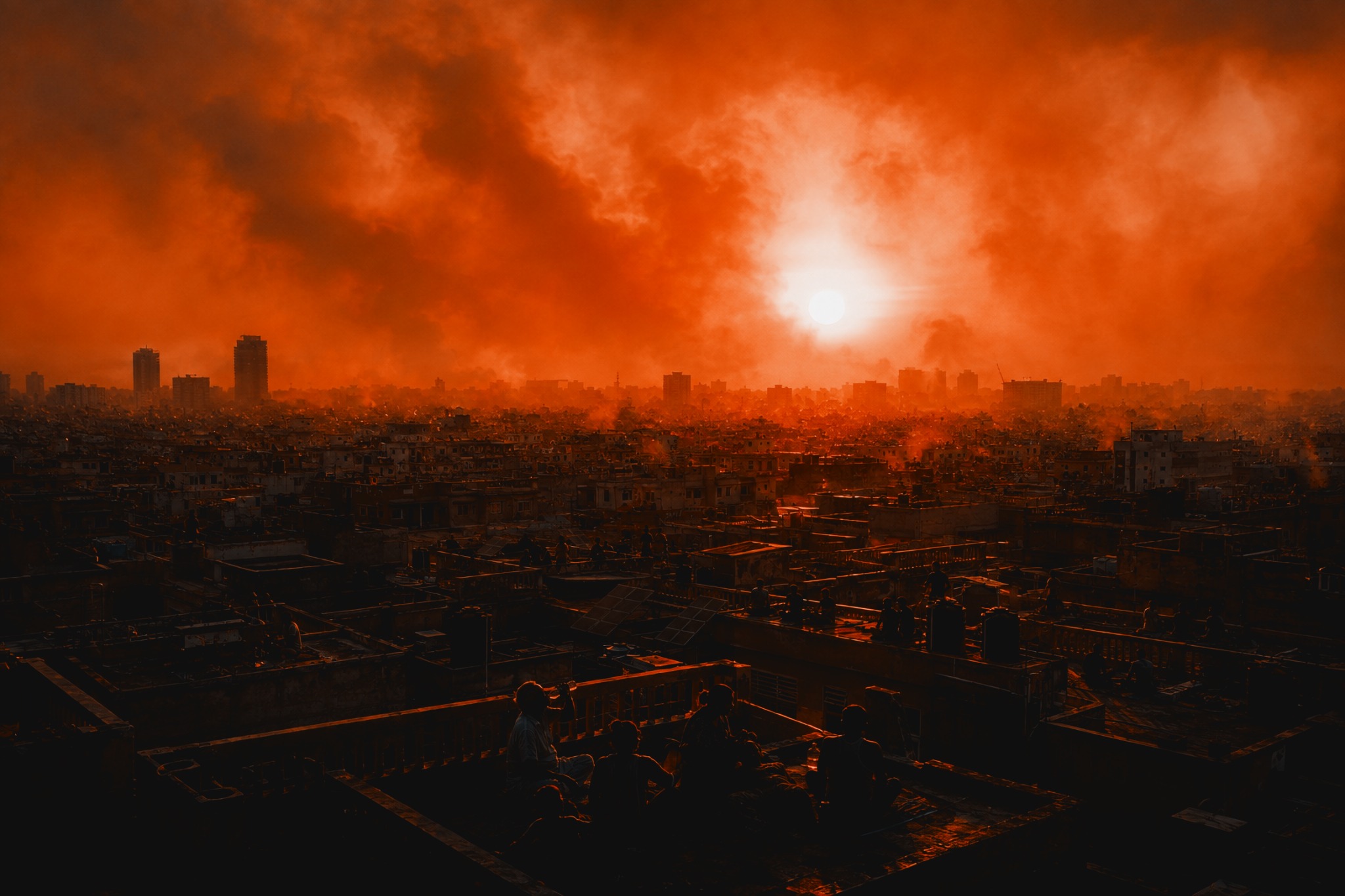
People seek relief on rooftops after the hottest day of the Great Humid Disaster in Karachi, Pakistan. Over 3,000 people are estimated to have died across greater Karachi during that day and night.
No reliable death count was possible. Bodies were buried without records. Migrant workers simply disappeared from payrolls. Deaths from kidney failure, heart disease, contaminated water, or interrupted medical care weren’t always logged as heat-related. Later estimates ranged from 6 million to 9 million direct and indirect deaths. Many survivors suffered lasting kidney, heart, and neurological injuries. Some lost their livelihoods when construction sites, ports, farms, and factories closed.
And the "Great Humid Disaster," as it was later called, broke what remained of global climate diplomacy.
The governments of Ethiopia, Kenya, Iran, Pakistan, and other states organized a Climate Justice Emergency Bloc that boycotted United Nations climate meetings. They argued that the high-emitting states had demanded restraint from poorer countries, while refusing to fund safe housing, reliable power grids, and water systems.
The governments of many wealthy countries replied that their citizens wouldn’t support open-ended financial or technology transfers during domestic emergencies. The UN climate framework survived on paper, but lost the ability to coordinate global mitigation or adaptation policies.
2095-2100: Everyone Became a Climate Loser
For a time, commentators divided the world into climate winners and climate losers.
Canada, Russia, Scandinavia, and a few high-altitude regions were expected to gain longer growing seasons, lower winter heating costs, and access to new resources. And indeed, some gains did unfold as expected. Agricultural lands did move north. Ports remained ice-free longer. Land values rose in places once considered too cold for comfort.
But even many genetically modified crops struggled in the thin, acidic, rocky, or waterlogged soils of the new, northern farms. Pests and plant diseases also moved north. Boreal fires destroyed timber, towns, and power lines. Thawing permafrost damaged infrastructure.
Migrants arrived faster than housing, schools, clinics, and water systems could expand. Even fortified borders couldn’t keep them out. Countries that remained physically cooler still depended on tropical crops, foreign factories, global shipping, stable finance, and political order elsewhere.
It soon turned out that economic models had underestimated the impacts of simultaneous, mutually reinforcing extremes in temperature, precipitation, and wind.
A heatwave didn’t only raise temperatures; it also increased the likelihood of drought and wildfires. And increasingly, when a heatwave ended, it didn’t give way to more comfortable weather – but rather to severe rains, or extreme winds. Then another heat wave would begin.
Weather extremes didn’t just kill people in a particular place. They raised food prices, discouraged tourism, damaged economies, worsened disease, weakened governments, and spurred migration.
A coastal flood, for example, closed ports and factories, delayed medicines, and interrupted the supply of transformers, pumps, and electronic controls needed to repair electrical grids. A heatwave slashed labor hours in construction, farming, transport, and mining precisely when societies needed to build the most infrastructure.
Repeated shocks changed investment. Money flowed towards emergency repairs of devastated infrastructure, or dubious efforts to rebuild ruined communities – rather than to schools, research, maintenance, and long-term adaptation.
Led by the United States, many countries ran obviously unsustainable deficits to recover from extreme weather. National debts reached dizzying new heights until governments defaulted, one after the other. Around the world, currencies depreciated, inflation soared, and many of the jobs remaining to people – rather than machines – disappeared.
By the early 2090s, a new, global Great Depression had arrived, and it seemed there was nothing governments could do about it. Violent uprisings ushered in a new age of strongmen and military juntas, even in many of the wealthiest and most democratic countries of the twentieth century.
Ultimately, there were no winners – because it turned out we were all connected. If only we’d come to that realization earlier.
Global greenhouse gas emissions were finally falling – not because climate policies were succeeding, but because economies had contracted, populations had declined, and some industrial systems no longer functioned reliably. This was not an orderly decarbonization. Carbon dioxide concentrations remained high, permafrost and damaged forests continued to release carbon, and the world hadn’t come close to reaching net zero emissions.
Today, Earth has warmed by about 4 °C, relative to its temperature in the late 19th century. And there’s little sign that the warming will stop anytime soon.
So far, humanity has survived, but only through desperate adaptations that, for most people, have made life poorer, more precarious, and shorter.
Many governments ration electricity, water, and food. They have closed borders, criminalized movement, and withdrawn public services from regions judged too costly to protect. Robots perform outdoor work, especially in the summer. Quarantines are a regular part of life.
Global civilization hasn’t collapsed – not yet. But governments, communities, ecosystems, and entire ways of life certainly have. Death is everywhere, and nobody takes the future for granted.
We know one thing for sure. The lush and stable Earth our ancestors once enjoyed is never coming back.
2100: No Safe Latitude
Four degrees of warming didn’t make the Earth uninhabitable – not exactly. It made habitability expensive, unequal, and, in many places, temporary.
A person could survive a Mendoza heatwave with reliable power, an insulated home, clean water, medical care, shade, and the freedom to stop working outdoors. Without those protections, the same heat could be lethal.
Mendoza remains a city. But it isn’t the oasis it once was. Drinking water comes from a tightly monitored mix of river flow, groundwater, and recycled wastewater. Gardens are small, fountains rarely run, and open acequias carry water in scheduled pulses, rather than every day. The urban forest is thinner, and younger.
This evening, the sun is sinking behind the Andes through smoke from fires in the foothills. The air is a toxic, suffocating orange. The channel below my apartment has been dry for eleven days.
It’s still 39 °C. But it’s already the middle of April: autumn in the southern hemisphere. The power authority has warned that cooling may be cut after midnight.
The day is ending. It feels like the heat never will.